It’s All About the Values

Like most organizations, Fambul Tok has a list of values to which it subscribes, and that it works to consistently fulfill.  Unlike many organizations in practice, however, it defines the living out of those values as one of the, if not the defining characteristic of its work. 
Living its values (and helping Fambul Tok communities live them), in other words, IS the work of Fambul Tok.  Seeing this exemplified in vivid ways was one of the highlights of my February trip to Sierra Leone.
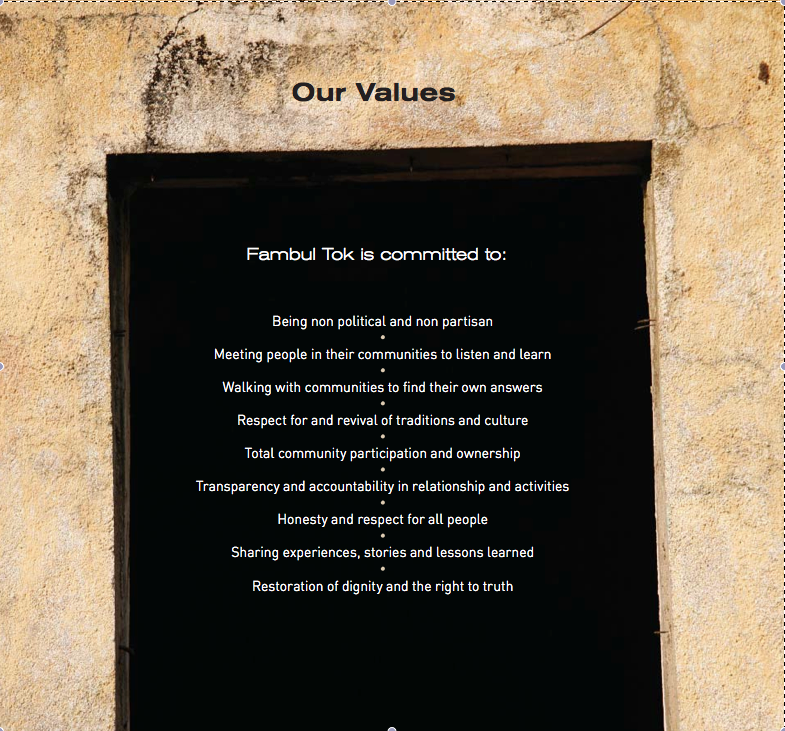
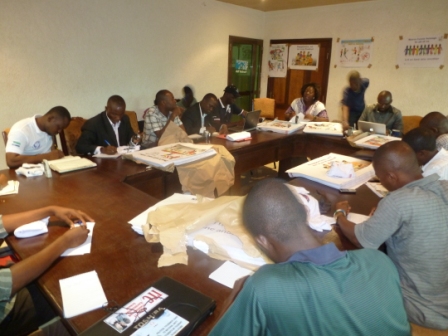
What does living and inculcating values look like in practice?  Every community meeting begins with an articulation of those values, and they become the criteria for participation in the meeting itself.  Fambul Tok’s first listed value is being non partisan and non political.  So leadership positions (organizationally and in the volunteer structures that are put in place for the community work itself) are reserved for those without explicit party affiliations.  In a highly polarized society like Sierra Leone, this is critical to creating local structures in which all citizens feel they can fully participate.  Clear and vigorous commitment to this value has protected the work from being hijacked for political purposes on many an occasion.  In the first “Stakeholders Meetings” in Pujehun district, which I was able to attend in

Staff member Sheku Koroma introduces Fambul Tok at a Stakeholders Meeting in Pujehun District

February (a Stakeholders Meeting is first step in Fambul Tok’s work in a new section, gathering the leaders of all the villages in that section to first share about Fambul Tok), you could watch the faces of the community members relax into the safety of that value, as the Fambul Tok staff explained the centrality of keeping the work fully separate from politics.

Given the core commitment to the work being owned and led by the communities themselves, and not dictated by Fambul Tok organizationally or other external parties, values which support that process are critical, and these process values are the one thing that does get “dictated” and reinforced by Fambul Tok.  As an example, all voices are considered worthy, and the process is meant to be all-inclusive – everyone is entitled and encouraged to participate. (“Total community participation and ownership,” is how it’s officially listed.)  This gets

The agenda for a stakeholders meeting

reinforced at many levels, for example in the selection of the sectional Reconciliation and Outreach Committees. Leaders from each village in a section choose members of their communities to represent them in these key Fambul Tok organizing committees.  But if, for example, they appoint someone who has a visible political agenda, or a leader only appoints members of his or her family, they are not approved by the FT staff, and the community will be sent back to the drawing board to appoint more truly representative people.

“Total participation” means full inclusion of women in all decision making structures as well, a requirement that has needed frequent reinforcement, given how much it challenges current culture.  Eventually, however, communities become self-reinforcing with this standard, with women either freely speaking or with the community members themselves inviting women who have remained silent in a meeting to speak, without having to wait for a FT staff member to do so.  Reinforcing the requirement for gender equity in the community structures challenges and reshapes tradition, and the impact is extending now beyond the Fambul Tok structures, as communities more broadly recognize the value and important leadership role of women.  For example, staff from Moyamba District shared that in 7 chiefdoms women had not been allowed to attend meetings where men were in attendance.  Because of Fambul Tok, that has now changed, and women are now going to all meetings.  The cultural norm that Fambul Tok establishes has spread outside of the FT context.

This same value of total participation is bearing fruit in other powerfully healing ways for individuals and communities.  In one notable example,
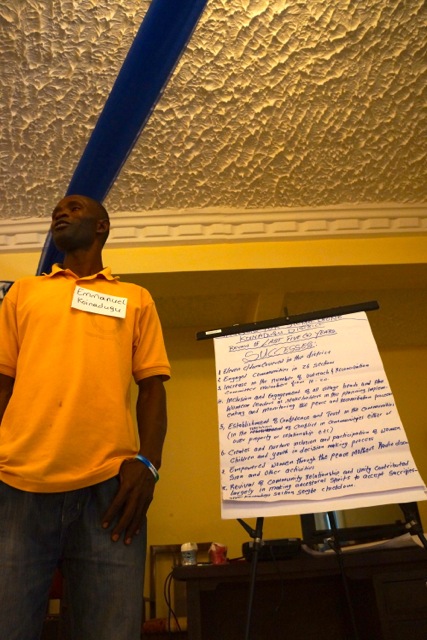
Rev. Emmanuel Mansaray at the national staff meeting

Koinadugu district staff member Reverend Emmanuel Mansaray shared a story from a recent bonfire in Kambamamuduya Section.  A man from that section had been captured and tortured by the rebels during the war, and was forced to kill his mother-in-law.  At the end of the war, he returned to his village and his wife, telling her simply that the rebels had killed her mother, but not admitting his own role.  Upon his return, he gradually slipped into insanity. He was rejected by all in his community and labeled as the town crazy, wandering the village and refusing even basic personal grooming.  At the village’s bonfire ceremony, when he stepped forward wanting to testify, several community members tried to prevent him, citing his insanity.  FT staff, however, insisting on the value of inclusiveness, made sure he had the opportunity to come forward.

He stood up and in his testimony admitted to being the one who had killed his wife’s father.  He had never told anyone before that he had in fact done so, and the guilt from that event had obviously so plagued him.  After testifying, he was forgiven by his wife and community, and he literally became a changed man – his sanity returned, and he resumed a productive role in his community – after they had collectively gathered and taken him to the river to bathe!

With so many of visibly insane people walking the streets of Freetown, or other, smaller communities in the country, many staff speculate that such unacknowledged guilt and trauma from the war may play a significant role in that.  At the February staff meeting, they began considering if there were a way to reach that population more systematically.

Kailahun District takes full ownership of Fambul Tok

On February 13, 2013, people gathered in chairs under a grove of trees on the outskirts of Kailahun town, the capital city of Kailahun District, to talk about Fambul Tok in their district, in a virtual repeat of the scene from 5 years earlier, when stakeholders from across the district gathered for one of the first Fambul Tok consultations (this conversation is featured in the Fambul Tok film).  At that time, John Caulker and his staff asked those gathered if they wanted to reconcile (the response was an enthusiastic Yes), and if so – how they wanted to do it?  The groundwork was laid for launching Fambul Tok in Kailahun, which became the pilot district for the implementation of the Fambul Tok program in 2008.

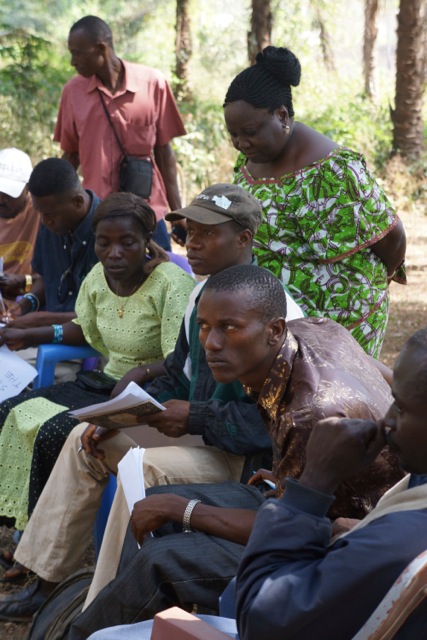
Representatives from all Fambul Tok sections in Kailahun District gather to plan running the program themselves

Now, Now, five years later, over 50 people again gathered in chairs under a grove of trees, for another consultation.  This time, however, each person represented a section (or group of 4-10 villages) where Fambul Tok had been actively working—hosting a bonfire ceremony and ongoing follow-up activities.  People from the represented sections told of village members vibrantly engaging in development projects together for the betterment of their communities and virtually all reported using the FT structures to peacefully resolve new conflicts as they emerge.

55 people, 55 villages – 5 years of deep reconciliation leading to individual and community healing.  The depth of experience represented was staggering to me, and I felt a wave of recognition of this visible symbol of how much had been accomplished.  Having just arrived for a 2-week visit to Sierra Leone (more stories to come…stay tuned!), I felt the substance and tone of the meetings was an auspicious way to begin my visit!  Hearkening back to the parallel scene of 5 years earlier made it so vividly obvious how much knowledge was represented in the group; how much transformation and healing of wounds; how much reknitting of communities; how much lived goodness.

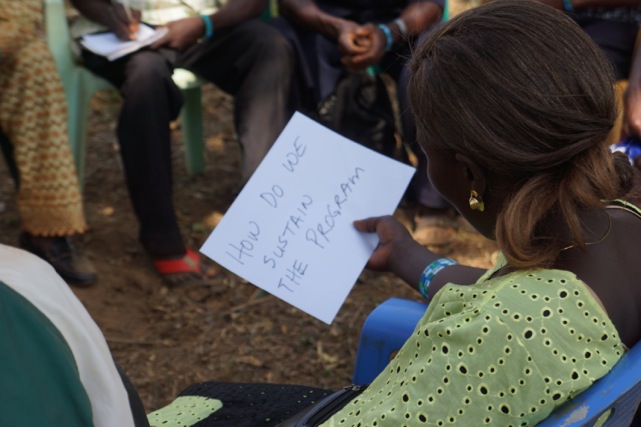
Planning for sustainability in Kailahun District

These 55 were gathered to initiate another first for Fambul Tok – the process of a district taking over the full running of the Fambul Tok program at the district level.  Eager to take the program forward fully on their own, the representatives gathered talked through the process of how to do that.  They decided to work toward establishing Fambul Tok as a district NGO, newly christened “Kailahun District Fambul Tok,” or KD-FT.   Delegates decided to divide the district into 4 zones, and they proceeded to elect zonal executive bodies (with equal numbers of men and women) to manage the ongoing work of Fambul Tok on the ground for Kailahun.  From those zonal bodies, one overarching District Executive was elected, to be the governing body for the whole district.

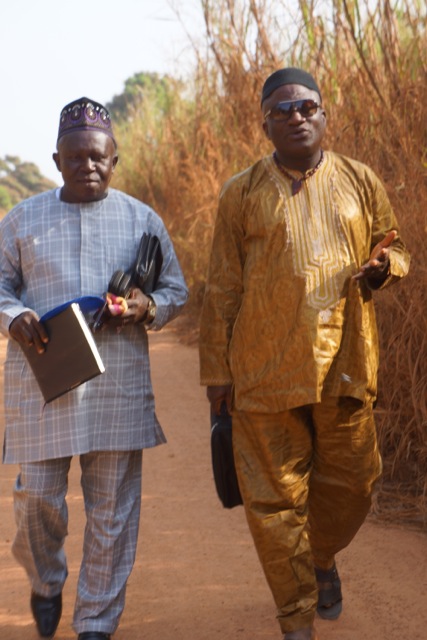
PC Gondor and Chief Ndolleh arrive at the meeting

Paramount Chief Cyril Foray Gondor, who was elected to Chair the new District Executive at the meeting, described the district as ready to take on the responsibility for continuing the expansion of FT across the district, and for ensuring the deepening of the work in the communities where it was already working.  “We must hold Fambul Tok with two hands,” Chief Gondor said.  “We must see it as like a child, our child,” he said.  He emphasized the importance of the district itself fully owning the program, and really making the Fambul Tok work sustainable in the district.  Most important in that process, he noted, would be capacity building for those in the district, to help support them being able to manage the work effectively, transparently, and fully according to the Fambul Tok values.

The national organization (FT-SL) will still retain close ties with the new district organization, supporting and overseeing KD-FT as it gets established – “walking with” (to use Fambul Tok’s language) the new Executive through the year as it builds the administrative structure, practices and knowledge to carry forward the work on its own.

Representatives plan for the work of running Fambul Tok at the district level

“The last five years were Fambul Tok Volume I,” said Chief Maada Alpha Ndolleh, the town chief of Kailahun Town and founding District Chairman of Fambul Tok there, who will continue an active leadership role in the district work.  “Now, we have Fambul Tok, Volume II,” he concluded.

A spirit of energy and commitment was evident everywhere. “Let’s embrace it now, as our own pikin, [Krio for child]” exhorted one delegate.  Several speakers talked about the importance of working  hard, and of people volunteering their time.  And many delegates noted how women were flourishing in the fambul tok process, recognizing how the future of their country depended on this continuing. Many noted how in a lot of the Fambul Tok follow up activities, especially the farms, women were outperforming the men.  “The women should lead us,” one man said, while another young man said, “The youth are ready to support the women.”  A requirement for gender balance on the executives will support this going forward.

District zonal groups discuss the way forward.

Delegates recognized the work ahead, but expressed a universal eagerness to embrace it.  “Let’s take the values that Fambul Tok taught us,” said local journalist and active Fambul Tok supporter James Fallah, “and go forward as one.”

Fambul Tok Advisory Board Welcomes Two New Members

Fambul Tok is delighted to welcome two new members to our advisory group – Iheoma Obibi and Aminatta Forna. This brings the total number of group members to nine. The organization benefits enormously from the advice and support which the members of the advisory group offer. Information about all advisory group members can be found at: https://www.fambultok.org/about-us/board. Here are brief biographies of our new recruits:

Iheoma Obibi

Photo courtesy of African Feminist Forum


Iheoma Obibi is a leading African feminist and peace-builder, with extensiveexperience providing training to rural and urban poor communities in Africa. She is Executive Director of Alliances for Africa, an African-led international NGO, based in Lagos, which works to promote and protect human rights, peace and sustainable development. She is an active member of the African Feminist Forum, along with its Nigerian chapter. She regularly acts as a trainer and facilitator on topics such as organizational development for CSOs; gender analysis, planning, mainstreaming and training; and third-party mediation. Over the years she has worked as a consultant for several international agencies, including UN Women, British Council, DfID and the Commonwealth Secretariat. In 2005, Iheoma was elected to the ASHOKA Fellows network, which invests in leading social entrepreneurs, serving for three years.  She is also currently Creative Director of a company called Mylid, which provides advice on sexual health and wellbeing to Nigerian women. Iheoma has published short stories in several online e-zines and anthologies. She is presently the Vice-Chairperson for Women Writers of Nigeria (WRITA) Lagos chapter.

Aminatta Forna

Photo courtesy of Aminata Forna’s personal website


Aminatta Forna is the award-winning author of two novels: The Memory of Love and Ancestor Stones, and a memoir The Devil that Danced on the Water. She was raised in Sierra Leone and Britain. Her most recent novel, The Memory of Love (Bloomsbury, April 2010) won the Commonwealth Writer’s Prize Best Book Award in 2011. She has also written essays and articles for leading newspaper and magazines. Her television credits include the documentary series Africa Unmasked (Channel 4) and, in 2009, The Lost Libraries of Timbuktu (BBC). She has been a guest presenter on BBC Radio. In 2003, Aminatta established the Rogbonko Project to build a school in a village in Sierra Leone, where she now overseas a number of projects in the spheres of education, sanitation, maternal health and agriculture. Aminatta is a Fellow of the Royal Society of Literature and sits on the Board of the National Theatre of Great Britain, on the General Committee of the Royal Literary Fund and the Council of the Caine Prize for African Writing. She is currently a judge for the 2013 International Man Booker Prize. Aminatta is Professor of Creative Writing at Bath Spa University and has often acted as a visiting lecturer and tutor of literature and creative writing.

Fambul Tok resolves election violence in Kailahun

The two former political rivals, Kumba (l) and Mariatu (r)

Fambul Tok International – Sierra Leone has resolved a serious post-election dispute and restored peace and unity in Ngainga village and the chiefdom headquarter town of Dea in Kissi Kama chiefdom, Kailahun district.

It was reported that immediately after the announcement of presidential results, provocation and personal attacks overwhelmed the community. There were reports of assault, intimidation and harassment, and daily activities came to a standstill.

Participants of the reconciliation workshop listen to their fellow community members

Chiefdom authorities tried to restore order but could not, as they were suspected to be playing partisan politics. The Sierra Leonean Police also played a significant role to restore law and order in the chiefdom but still did not yield any tangible results.

In Ngainga village, the section chief, Tamba Kamanda, discovered that his residence had been vandalized by a group of people. Violence also erupted in Dea town as the entire township was divided between members of the All People’s Congress and the Sierra Leone People’s Party. The whole chiefdom was under siege.

It was realized that the reason for the continued violence could be attributed to two influential women who were close prior to the elections but fell out on political differences. One of them, Mariatu Tamba, is the wife of the All People’s Congress councilor elect. Kumba Sesay, the other woman, supports the opposition Sierra Leone People’s Party. Their followers were in conflict on a daily basis.

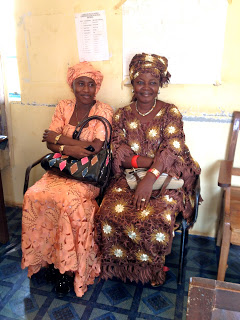
Mariatu and Kumba reconcile (center is Fambul Tok’s Micheala Ashwood)

In its post-election activities in Kailahun district, Fambul Tok district staff realized that Kissi Kama chiefdom was in disarray, and even when the organization held meetings to evaluate the impact of the election, community members boycotted. Determined to ensure that the chiefdom was at peace, staff from Koinadugu, Moyamba and Freetown joined their colleagues in Kailahun to work toward the restoration of peace in that key part of the country.

As the situation deteriorated, the Paramount Chief and chiefdom authorities called their usual monthly meeting to discuss how to tackle the problem, as different approaches had earlier failed. Fambul Tok used their December 5 meeting to prevail on conflict parties to be at peace since elections are now over.

The two women, Mariatu and Kumba, were given the floor to express whatever they had in mind. The atmosphere resembled that of traditional bonfires, and also gave the community the opportunity to participate in the resolution and administration of their chiefdom.

After a very tense session, Fambul Tok National Coordinator of Peace Mothers, Micheala Ashwood, called for a cooling-off period. She asked the conflicting parties to come forward, swallow their pride and reconcile. Micheala went on to cite the example of the recent meeting of newly reelected President Koroma and the leader of the opposition Sierra Leone People’s Party, Julius Maada Bio, at the Statehouse in Freetown, adding that if those two political heads had met to show they are committed to peace, there is no reason why the people of Kissi Kama could not also emulate such practice. She asked them never to allow themselves to be divided again, and to work in the spirit of reconciliation and development of the chiefdom.

Both Mariatu and Kumba reconciled and used the meeting to appeal to their followers to bury the hatchet as elections and move forward together.

After the reconciliation, the whole township of Dea went into jubilation. Mariatu and Kumba were once again seen as sisters as they walked together amidst their neighbors’ dancing.

As a commitment to the peace, Mariatu decided to withdraw an assault case she earlier brought against Kumba at the Kailahun Police station. They hired a motor bike from Dea town to Kailahun, and when they were spotted by villagers, there was thunderous applause as the community witnessed Mariatu and Kumba riding on the same motor bike.

The reconciliation was seen as  a very big relief for the chiefdom and the entire Kailahun district. To culminate the occassion, Fambul Tok also organized a reconciliation football match in Dea and a disco at night on December 5, 2012, in which the entire community joined to rejoice.

“We are fed up with political violence,” Koinadugu women exclaim

A snapshot of participants in Kabala

The newly trained Community Peace Ambassadors in Koinadugu district, north of Sierra Leone vowed to leave no stone unturned to ensure that the November 17,2012 multi-tier elections in the country were free from violence, intimidation and harassment.

Community Peace Ambassadors in Kabala

“We are tired of political violence and we will volunteer  our time and efforts to do everything possible to ensure that the elections are free, fair and credible” explained the chairlady of Fambul Tok Peace Mothers in Heremakono, Wara Wara Yagala chiefdom.

During a one-day training in Kabala on Tuesday November 6 ,2012, participants from all eleven chiefdoms in Koinadugu district were extremely grateful to Fambul Tok for organizing such a sensitive training session for rural women in that part of the country.

In her testimony, one of the Community Peace Ambassadors, Mrs.Marah from Mongo chiefdom, gave a brief account of how they were subjected to violence, harassment and intimidation during the 1977 general elections in Sierra Leone. She explained that during that period, politicians used thugs to attack their village and in the process many people fled. Mrs Marah joined the other women to denounce violence and promised that after the training they would continue to work with anyone responsible for the conduct of the elections so that peace would prevail before, during and after the electioneering period.

Another participant, Margaret Mansaray, explained how she prevented chaos in Wara Wara Bafodia chiefdom during the awarding of symbols to candidates. She said through  Fambul Tok’s experience, especially in reconciliation and peace, she swiftly intervened to avert violence during that time.

One of the women in Kabala explained how two candidates contesting for a single Parliamentary symbol in one of the political parties reconciled in the township as the losing candidate who had heard about Fambul Tok reconciliation activities in the district prevailed on his supporters not to fight in the interest of peace, but called on them to vote in the winner. Madam Kadiatu Kamara said they were so impressed that day when the two candidates embraced each other, as everyone thought their supporters would resort to fighting and further violence.

She stressed that Sierra Leone belongs to all of us and went on to denounce violence in any form or shape.

Other participants shared their experience and before the training ended, they all pledged to work hard to ensure the elections were violence-free.

The Community Peace Ambassadors were given posters and T-shirts with peace messages to preach peace in their various communities.

Fambul Tok trains peace ambassadors on non-violent elections

Peace Mothers with their facilitators guide

As Sierra Leone prepares for presidential, parliamentary and local council elections scheduled for November 17, 2012, civil society, the government, the security sector and the international community have expressed grave concern about the potential for electoral violence, given the history of antagonism among political parties.

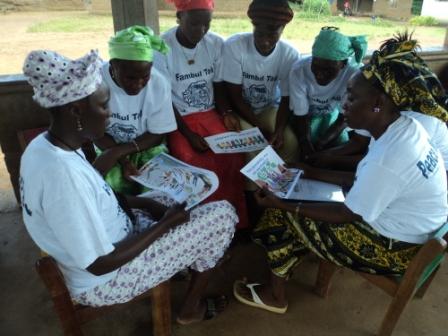
Peace Mothers analyze peaceful messages

In the past elections, Sierra Leoneans have witnessed political violence such as physical assault on candidates and their supporters, threats and intimidation of candidates and voters, and provocation propaganda. Women are always at risk of such violence and there have been instances where female candidates and their supporters have been subjected to intimidation, harassment, and even physical assault by forces who oppose women’s candidacy. Such violence and fear have the effect of deterring both female candidates and voters from casting ballots.

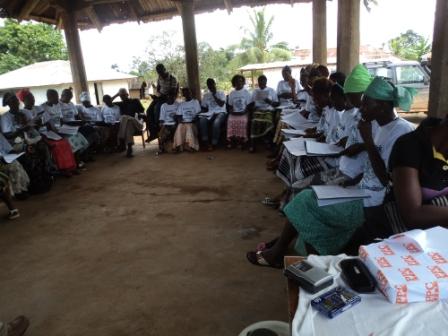
Group work session

As women play a vital role in the restoration of peace and democracy during the country’s conflict, they also have the potential to be leaders for peace throughout the election cycle.

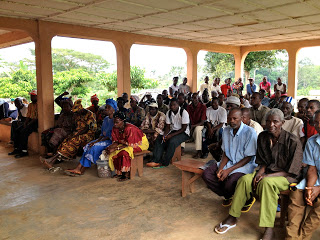
Meeting attendees

In this vein, Fambul Tok, with funds from the people and government of the United States of America, proposes to work with Peace Mothers in Kono and Kailahun and other potential civil society groups to empower women to act as leaders for peace and stability in their communities in two ways — to amplify their voices in support of peace, non-violence, and political tolerance before, during, and after the elections and to develop cooperative relationships with election authorities such as local chiefs, police and district committees monitoring political parties conduct in order to prevent and respond to election-related conflict. Peace Mothers will also have the opportunity to attend District Code of Conduct Monitoring Committee meetings to have clear knowledge on the role of the committees  and to to understand the ‘dos and don’ts’ of the Sierra Leonean Police.

Prior to the training sessions in Kono and Kailahun districts, a planning workshop was organized by Fambul Tok International – Sierra Leone to give an opportunity to different women’s groups to develop potential peace messages to be used in communities before, during and after elections. Peace Mothers in the provinces also gave input on the messages (both pictorial and verbal) in order to improve on them.

A facilitator’s guide was designed as a tool  for community peace ambassadors who will lead the process of ensuring that women participate in enhancing violence-free, fair and transparent 2012 elections. The guide includes peace messages for radio and community discussion, basic information on mediation skills, and the role of the District Code of conduct Monitoring Committees and the Sierra Leone Police.

The peace ambassadors, two from each chiefdom in Kono and Kailahun districts, are also expected to train their women folks and organize chiefdom meetings in their various communities.

Hate Speech Will Undermine Reconciliation Process

Executive Director of Fambul Tok International–Sierra Leone, John Caulker, says the reconciliation process championed by his program will go down the drain if politicians continue preaching hate speech and negative messages during the country’s electioneering period.

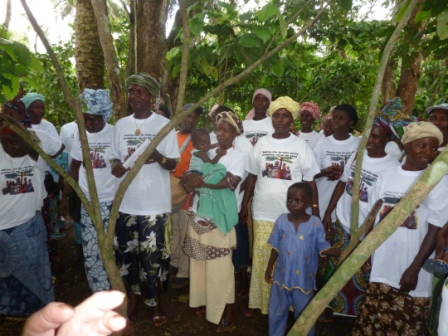
Peace Mothers declare peace in November polls

“Fambul Tok as a reconciliation organisation is very much concerned  and we are really frustrated over the use of hate speech by politicians as our efforts in reconciling people across the country will be worthless if anything negative crops up before, during and even after the November 2012 polls,” John Caulker lamented.

Addressing the press

He made the remarks during a press conference on Monday, October 29, 2012, as he addressed the media on Fambul Tok activities, especially towards its efforts in the forthcoming elections.

He said that if Sierra Leoneans want a country that is free from conflict, then they should refrain from the use of hate messages that have the potential to invoke trouble and other forms of violence.

Peace Mothers display posters

Mr. Caulker reminded media practitioners of their responsibility to report objectively and impartially in condemning anyone that propagates hate speech, adding that such utterances have the propensity to degenerate into violence. He went on to state that Fambul Tok expects politicians to be preaching their party’s platform in order to win the hearts and minds of Sierra Leoneans rather than resorting to negative statements.

“We have put all our resources together to engage in peaceful sensitization activities in the country so we don’t want to see a situation where our resources and efforts will be in vain because of violence in the electioneering process,” Caulker emphasises.

He touched on his recent visit to the United Kingdom where he addressed students at the Hilford School in London. He also mentioned on-going academic discussion done in collaboration with Academia–Sierra Leone.

Head of Peace Mothers, Fambul Tok, Micheala Ashwood spoke about recent activities of Peace Mothers in Kono and Kailahun. She disclosed that 56 Peace Mothers have been trained as community peace ambassadors to relay peace messages in their various communities.

interpreting the posters in Faada,Gbense chiefdom

Ms. Ashwood said that the primary responsibilities of the ambassadors are to maintain peace and to link with stakeholders in the electoral process to ensure violent-free elections. She mentioned the recent chiefdom meetings in Fiama and Gbense in Kono district where Peace Mothers contributed and vowed to preach peace in their various communities. The peace mothers will also meet the District Code of Conduct Committee members and the Sierra Leone Police to learn about their roles in the electoral process.

Fambul Tok continues to inspire with screenings around the world

Almost two years since our world premiere, Fambul Tok continues to engage audiences in film festivals and community screenings worldwide. In just the past three months, Fambul Tok has screened in every time zone in the continental U.S., and on four different continents. The television premiere and DVD release have only fueled the film’s popularity on the festival circuit. Why? Because Fambul Tok resonates best when it is seen, celebrated and discussed collectively. It is a film that demands to be shared.

At the Interrobang Festival in Des Moines, IA, the Santa Rosa International Film Festival in Santa Rosa, CA, the Montreal Black International Film Festival in Quebec and Hong Kong’s Pineapple Underground Film Festival, audiences are joining the fambul. In addition to its public screening at the BolderLife Festival in Boulder, CO, Fambul Tok was chosen for a select, education-focused block for area schools, bringing youth into the conversation about forgiveness.

Following our June screening at the Biografilm Festival in Bologna, Italy, L’Africa Chiama, a nonprofit based in Fano, screened the film as part of a week-long examination and celebration of African culture. Fambul Tok was also utilized by the Swedish government’s agency for peacebuilding, Folke Bernadotte Academy, in training seminars with the Kenyan National Cohesion and Integration Commission. The ideas of Fambul Tok found traction with the international and Kenyan representatives in Naivasha and Mombasa exploring the potential for reconciliation and memorialization within Kenya’s current political and legal framework.

On Sunday, October 7 at 5pm, Fambul Tok had its first official hometown festival appearance in Portland at the Portland Maine Film Festival. Following the screening, Producer/Executive Producer Libby Hoffman will host a Q&A session. We’ll also be screening in Portsmouth, New Hampshire with the New Hampshire Film Festival on Friday, October 12 at 10:20am, and are eagerly awaiting our Washington, DC festival premiere next month at the Washington West Film Festival.

‘Fambul Tok’ to be core subject in schools

The Principal of the Modern School of Science and Technology in Makeni has urged the Ministry of Education Science and Technology to include ‘Fambul Tok’ as one of the core subjects in all educational institutions in the country.

John Kanja Koroma made these remarks during presentation ceremony of Fambul Tok (the book) and the second year report to the school.

Presentation of Fambul Tok books (From left to right- Student Isatu Sesay, Principal John Kanja Koroma, and Fambul Tok Team Leader Joseph Kargbo)

According to him, Fambul Tok, which aims at community reconciliation is very important, not just in Sierra Leone but in other post conflict countries as well. He reminisced that, over three decades ago, schools were offering courses on civic education, which taught pupils how to identify and exercise their rights and responsibilities as citizens. Such important subjects have since been wiped from the regular school curricula.

Koroma stressed that due to this change, pupils do not know the rights and responsibilities accorded them, and are unprepared to participate in their civic duties.

The Principal went on to state that Fambul Tok activities are very important, as they heal communities and reconcile broken relationships. He noted that if the government, through the Ministry Of Education, Science and Technology, pays special attention to Fambul Tok as a key reconciliation tool and introduces it as a subject in schools, it will help students to contribute toward promoting peace and reconciliation  in the country.

Team Leader of Fambul Tok in Bombali district, Joseph Kargbo, urged pupils to make use of the Fambul Tok book,adding that it will help them to know more about their ancient traditions leading to healing and reconciliation.

One of the pupils, Isatu Sesay, while giving a vote of thanks, appealed to her colleagues to read the book and process the contents in a practical and relevant manner. She also urged them not to be selfish by depriving others through consistent borrowing of the book from the school’s library.

Students in rapt attention during presentation

This development makes great progress in the integration of Fambul Tok into the school system.  It will be a matter of time to see whether or not these concepts are fully embraced. In the meantime, other schools, such as Birch Memorial, Benevolent and Binkolo Secondary, about 5 km from Makeni are yearning for Fambul Tok staff to visit their campuses.