Announcing new short film on Peace Mothers

The women of Sierra Leone suffered uniquely during the 11-year civil war, yet they are now leading the way to peace in their country. Calling themselves “Peace Mothers” their courageous example is inspiring others around the world and illuminating a new power for peace to celebrate this Mothers’ Day.

To help celebrate this power for peace, Catalyst for Peace is thrilled to release a new 5-minute short film telling their story:

The Peace Mothers
The Peace Mothers

In fact, our Mother’s Day celebration in America has its roots in peacemaking. After the horrors of our own Civil War, Julia Warde Howe (famous for writing The Battle Hymn of the Republic) called for a national Mothers’ Day of Peace in 1870. When you read her stirring Mother’s Day Proclamation and watch the Fambul Tok Peace Mothers proclaim their optimism for their families and their country, you will see how they speak to each other across generations and across borders.

The Peace Mothers
Fambul Tok Peace Mothers

As Fambul Tok‘s program of community reconciliation was growing across the country, village women said that in addition to the truth-telling and reconciliation bonfire ceremonies, they also wanted some focused time to come together as women. Simply to come together. And the rest, they said, would take care of itself.

And did it ever. Choosing the name of Peace Mothers, these resilient women have unleashed an astounding energy for community development. They talk with each other, creating networks of wisdom and care to heal wounds from the war. They plant crops, build community spaces, speak up in community meetings. They sing. They dance. And when you watch our new, five-minute film about the Fambul Tok Peace Mothers, I know you will be as inspired by their global vision of motherhood as I have been.

Come back to the blog to learn more, and read regular updates on all that the Peace Mothers are accomplishing in Sierra Leone.

The Peace Mothers show that empowered, nurturing, connected women are essential to building better communities – and better nations.

Will you join me in reclaiming Mothers’ Day as a day for peace?  

Watch the Peace Mothers’ story.  Share it with your friends, families, colleagues.  And then join with us in coming together to ask – what can we do today to help bring the gift of peace to our community and to the world?

Happy PEACE Mothers’ Day!

-Libby Hoffman, Producer

Former ‘Rebel’ Eager to Return Home


Baindu appealing to elders to accept his brother Sensie back to his community

Baindu appealing to elders to accept her brother Sensie back to his community

Senesie, a former fighter of the defunct Revolutionary United Front of Sierra Leone is eager to return to his homeland in Kpanga Kabondeh, Pujehun district, in the south of the country. Senesie’s quest to return home was expressed by his sister, Baindu Kamara, during a bonfire on March 15, 2014, at Wombe village in Kpanga Kabondeh chiefdom.

Testifying before hundreds of villagers, Baindu disclosed that her brother caused a lot of havoc during the war in that part of the country, adding that she has been confronted on several occasions by individuals about her brother’s acts.

Baindu apologized on behalf of her brother and asked everyone whom Senesie had wronged to forgive him in the spirit of reconciliation. The reconciliation committee echoed Baindu’s plea and asked local authorities to forgive Senesie. Baindu also requested Fambul Tok to in assist Senesi’s return home, so he can openly apologize. Senesi is presently staying in one of the chiefdoms in the district.

Peace Mothers’ Pledge to Raise Ten Million Leones

Through their usual monthly contributions and micro credit scheme, Peace Mothers in Fakoi section, Fakunya chiefdom in Moyamba district have unanimously agreed to raise over ten million leones (Le10,000,000). This decision was reached at their monthly meeting held in Baoma Johnson village on April 5th, 2014.

peace mothers displaying their monthly contribution

Peace Mothers displaying their monthly contributions

According to the chair lady of the Peace Mothers’ group, Madam Battu Robert, the proposed goal is to start a project aimed at producing large quantity of gari, fufu and other food stuffs to be sold to the public.

“Presently we have collected two million leones (Le2,000,000)  through the loan scheme, and we are now targeting Le10m to buy mills (both rice and gari machines) to start large scale production,” says Madam Robert. She went on to state that the women meet on 5th of every month, adding that during the monthly meetings each member contributes Le5,000 and after collection the money is given out as loan to be repaid against the next meeting.

bags of gari in store

Bags of gari in store

Last year, the women harvested over 20 bags of husk rice from their inland valley swamp. Some of the harvest was sold and reinvested in gari production. This year, according to the women, a large area of the inland valley swamp will be cultivated in addition to the vegetable and gari production.


Peacemakers Commemorate ‘March 23’ with Quiz and Bonfires

March 23, 1991 is always remembered as a day of reflection. It was the day when the first shot was fired in the town of Bomaru, Upper Bambara chiefdom, Kailahun district, declaring war in Sierra Leone.

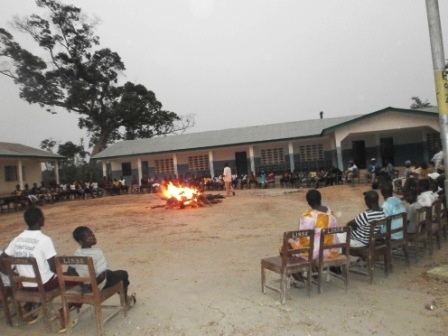
bon fire at Luawa Islamic secondary school in Kailhun

Bonfire at Luawa Islamic Secondary School in Kailahun

To commemorate March 23rd this year, peacemakers in 30 schools in Fambul Tok operational districts (Kailahun, Kono, Moyamba, Bombali, Pujehun and Koinadugu) embarked on various activities. What cut across all the school activities was the conduction of quiz competitions and bonfires.

The quiz competitions among the student peacemakers tested their knowledge of the national history of Sierra Leone and the Fambul Tok educational guides.

best competitor presented with FT T-shirt in Pujehun

Best competitor presented with FT T-shirt in Pujehun

The bonfires in schools are geared towards educating peacemakers on peacebuilding, emphasizing what caused the war and how children who did not witness the conflict can learn from the past. The bonfires also help build peace in studnets’ school environments and homes.

During the bonfires, people who were either victims or witness the conflict were invited to share their experiences, cautioning the students as young pupils not to be involved in any act or form of violence.

a winner in Kailahun

A quiz winner in Kailahun

The peacemakers are urging the  government to declare March 23 of every year a national day of reflection, during which the country of Sierra Leone would sit back and reflect on what went wrong and why they took arms against each other, destroying thousands of lives. The day would also be used to remind people that never again shall we take arms against our fellow country men to fight.

Peace Mothers support young girl’s educational goals

Peace Mothers in Lungili section, Kaiyamba chiefdom, Moyamba district, have prevented one of their members’ daughter from dropping out of school.

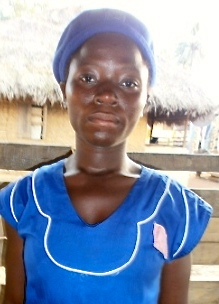
Student Betty Allie will continue with her studies thanks to Moyamba district Peace Mothers

Student Betty Allie will continue with her studies thanks to Moyamba district Peace Mothers

The 12-year old child, Betty Allie, had passed her National Primary School Examination with flying colors but her mother, a single parent, found it difficult to pay the fees for Betty to enter Junior Secondary School (Harford Secondary School for Girls) in Moyamba town.

Madam Betty, mother of the child, tried very hard to get loans to ensure that her daughter was admitted but could not. Betty was on the verge of losing her offer of admission, when the Peace Mothers’ came to her rescue. It was during a general meeting when the group decided to loan Madam Betty enough to pay her daughter’s fees. The loan was given unconditionally without any strings attached.

When speaking to Madam Betty at Lungi village recently, she extended her thanks and appreciation to the group, adding that had it not been for the timely intervention of the women her daughter would have dropped out of school.

Now, young Betty Allie is doing well in her studies at Harford and promises that she will continue to excel to ensure she gets the best education possible and to help support her poor mother and siblings.

Peace Mothers’ chairlady re-instated

Had it not been for the timely intervention of Fambul Tok staff, the entire Peace Mothers group in Saba two section, Sowa chiefdom, Pujehun district, would have dissolved. This was due to accusations by group members that their chairlady, Madam Amie Kijan had misused their funds and left the village unceremoniously. They stated that unless Kijan reported to them officially, they would no longer be interested in the group. Kijan was relieved of her position immediately.

The restored chairlady addressing the crowd

The restored chairlady addressing the crowd

Nearly two weeks after leaving Fayama village, Madam Kijan failed to turn up for the proposed date for Peace Mothers to open their account, which made them impatient. Members were in disarray and they even failed to meet for their usual monthly meeting. The situation deteriorated to the point where they wanted to dissolve the group. Fortunately, Fambul Tok had scheduled sectional dialogues on the gender laws and child rights act for all community members including Peace Mothers. Prior to the dialogue, staff were briefed on the situation in the section, relating to Madam Kijan.

A meeting was called and Kijan was given the opportunity to explain her absence, especially the accusations that were levied on her. She told her audience that she had family problems as her relative was murdered in cold blood in Bonthe district. At that point everyone was shocked and expressed condolences to the bereaved family members. On the alleged misuse of funds, Kijan stated that she was sorry that she did not inform the general membership. She clarified that she did not misuse the funds. She showed deposit slips and other documents from council, adding that the signatories could testify that she used her own money, as the funds were not enough to do all the banking procedures.

After showing all documentary evidence, the Peace Mothers were satisfied with her explanation and one of them said Kijan should have told them so that every member would not have pointed an accusing finger on her. Fambul Tok staff also called the entire membership to forgive Kijan in the spirit of reconciliation and restore her to her former position. Amidst singing and dancing, Kijan was reinstated!

‘Empowering Women’ is theme of Fambul Tok meeting

The Chairman, Alex Bhonapha, of the Kailahun District Council has emphasized that Fambul Tok International—Sierra Leone should take the onus to go beyond reconciliation in post conflict Sierra Leone and elsewhere.

Chairman Bhonapha addressed Paramount chiefs, councilors, Fambul Tok Peace Mothers and local authorities in a one-day meeting organized by Fambul Tok on how to empower women to be part and parcel of the local governance structure. “Fambul Tok has done much and continues to do more especially bringing communities together to work on development projects,” he said. And one of the things recommended by the Truth and Reconciliation Commission was “a need to go beyond conflict resolution.” He added that after the folding up of the Commission, Fambul Tok became the sole organization working toward community reconciliation. The chairman stated that Fambul Tok needs to expand its programs nationwide, noting that other communities are eager to reconcile but the space has not yet been created.

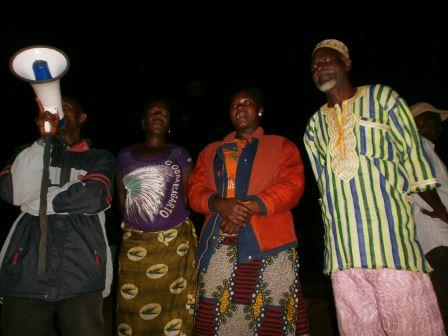
Chairman Alex Bhonapha addresses Paramount chiefs, Peace Mothers, councilors, and local authorities

Chairman Alex Bhonapha addresses Paramount chiefs, Peace Mothers, councilors, and local authorities

He briefly explained the local governance structure, stating that the local council is sub-national, responsible for governance at grassroots level. While it is supported by the central government, the council is charged with the responsibility to source more funding through taxation, levied charges on housing, stalls, and the like.

Chairman Bhonapha said women play very important roles towards governance and stressed that there is a need for women to be involved in governance.
During the meeting, Fambul Tok Peace Mothers stated that they are not always briefed on council’s activities even though they have elected councilors and ward committee members. Most councilors agreed on the issue of needing to do more outreach and said it is due to the fact that they don’t have enough funding to call together meetings.

Fambul Tok International Executive Director, John Caulker, discusses the topic of empowering women

Fambul Tok International Executive Director, John Caulker, discusses the topic of empowering women

The Executive Director of Fambul Tok International—Sierra Leone, John Caulker, in his statement, said that the way forward after the meeting in Kailahun was to find ways for women to engage council members to hear them and meet their needs. He said most things are centralized, adding that Fambul Tok would work with council to facilitate some outreach, especially for registration of customary marriage and the provision of resource materials at the sectional level.

At the end of the meeting, local authorities and councilors agreed to reach out and include Peace Mothers in not only the decision-making processes but also as part and parcel of the development drive in the district.

Section Chief Apologizes

Section Chief Komba Sebba has not been in a good relationship with his elder brother, Aiah Sebba for over ten years. He accused Aiah of campaigning against him when he attempted to be elected section chief of Dumbia in Fiama chiefdom, Kono district. When Komba won, Aiah declared that he would never work with his brother as long as he stays as section chief.

Due to this, some traditional leaders intervened but it was a fruitless endeavor as the situation between the two siblings deepened. The whole section suffered either directly or indirectly as Aiah is also an influential person in that community.

During Fambul Tok bonfire night in Yikior village on February 20, 2014, Komba, a member of the Reconciliation Committee came out and testified that he had wronged his elder brother and they have not been on speaking terms for over ten years. He told the gathering that he, as a member of the committee, thought it fitting to apologize for all that he has done.

Chief Komba Sebba shakes hand with his brother Aiah Sebba

Chief Komba Sebba shakes hand with his brother Aiah Sebba

Accepting his apology, Aiah said he had problems with Komba over chieftaincy, adding that he did campaign against him to lose the election. He also told the gathering that Komba failed to hand over some items he gave him for safe keeping during the war.

The Reconciliation and Outreach community members joined Komba to apologize to Aiah amidst singing and dancing. They hugged each other and sobbed for a few minutes. There was much jubilation in the entire community upon seeing the once divided brothers embracing each other.

Footballs for Fambul Tok Inaugurated in Sierra Leone

Post written by Gabe Hoffman-Johnson, creator of Futbols for Fambul Tok

I went to Sierra Leone in December to inaugurate the Footballs for Fambul Tok (FFT) program (see my earlier blog post for the program description). I want to do my best in this post to describe the amazing events that happened throughout the trip, and share the stories with everyone who supported the program, especially the Dartmouth College and Falmouth High School/Soccer communities.

FFT beginnings

DSC02036

Giving out footballs to Fambul Tok teachers

Before I talk about the trip, let me back up and explain how the donations process went in the United States.  Footballs for Fambul Tok was officially launched with the help of the Dartmouth College Men’s soccer team and the Dartmouth Athletic Department.  We collected soccer ball donations at our home game v. Columbia on Saturday, October 26th, 2013, where fans got in free if they brought a ball to donate. We had an amazing turnout, and collected over 200 balls.  Our Dartmouth soccer fans are amazingly supportive.  One family alone brought close to 50 balls! (Thanks, Defreggers!  You can see one of the happy recipients your generosity in the picture above.)

I orchestrated a similar event through my former high school coach, family, and friends, where the Falmouth High (Maine) boys and girls teams used their end of the season soccer banquet to collect balls. The Dartmouth and Falmouth soccer programs additionally donated a large number of training shirts for the members of the school peace clubs in Sierra Leone to use as uniforms.

IMG_1979

Fambul Tok teacher looks through the donated balls

Lots of people have volunteered their support, but I want to give a special shout out to Natalie Flowers, Drew Galbraith, Donnie Brooks, and other members of the Dartmouth Athletic Department, as well as Men’s Soccer staff for their help. I also would like to thank the families in Falmouth, especially the Bohrmanns and my longtime coach, Dave Halligan, for all their help with the Falmouth High School soccer teams’ major donations.  The interest, excitement, and support from both school communities has been inspiring.

In Sierra Leone

Our visit to Sierra Leone was more rewarding than I could have ever imagined.  My Dartmouth teammate, Colin Skelly, came with me, and we were there for a week in the beginning of December. I had visited Sierra Leone once during my freshman year, but it was Colin’s first time to Africa!
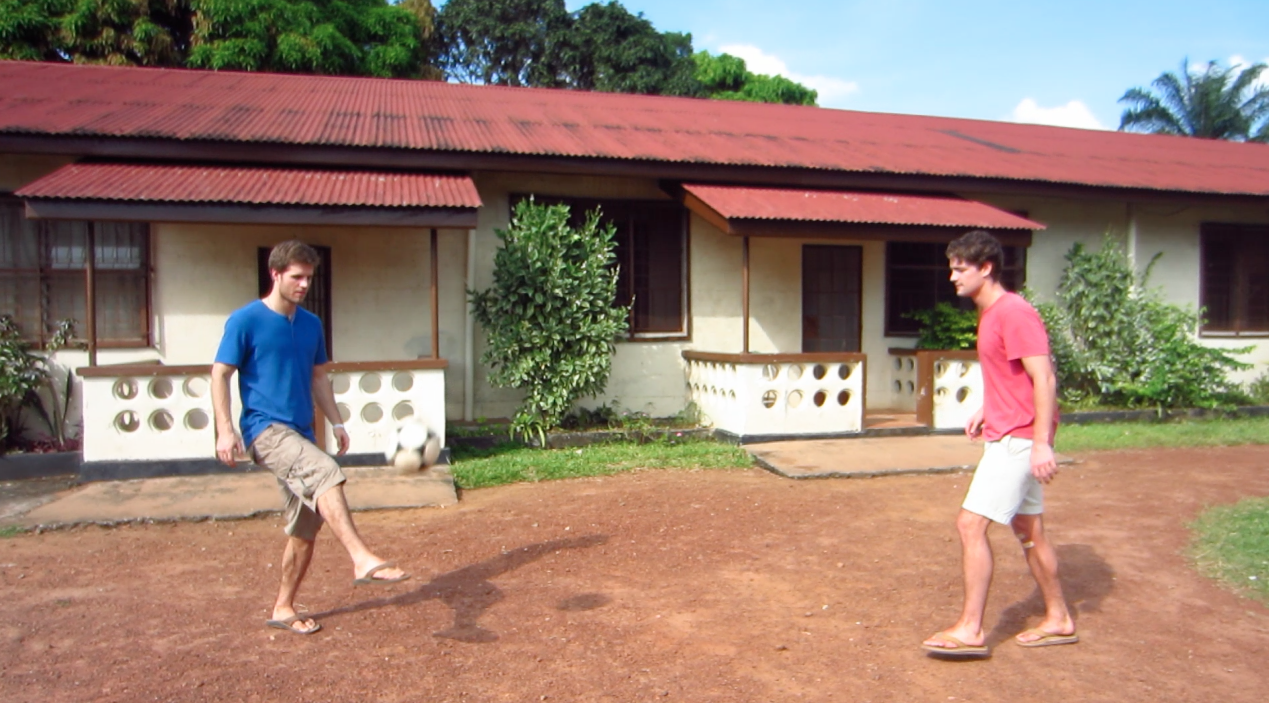
Colin and Gabe play at the Kenema Pastoral Centre

Colin and Gabe play at the Kenema Pastoral Centre

Immediately upon our arrival, Fambul Tok held a two-day training program for sixty teachers from thirty different schools across most of the country.  The teachers involved lead the Fambul Tok Peace Club programs in their schools. These Peace Clubs had either recently been instituted or were in the process of being initiated in their schools. The Clubs are made up of predominantly middle and young high school age children, who show extraordinary efforts in the classroom or their communities.

The Fambul Tok staff thought linking FFT with the school clubs program would be the best way to make an impact, and would directly support Fambul Tok’s youth programming.  Colin and I were able to donate four balls to each school with a Fambul Tok Peace Club.  Most of these schools did not have any balls, or the balls they had were in bad shape.  The teachers’ reaction to our donations was something I will never forget!  There was so much gratitude and pure joy in the room it was quite moving and I found myself a little choked up, witnessing the first ‘Footballs for Fambul Tok’ having come full circle.

Originally my idea was for FFT to support Fambul Tok’s general work in the communities. However, our timing and focus aligned perfectly with the creation and goals of the Peace Clubs, so it made sense to evolve into a focus of supporting them.  Focusing our donations on the Peace Clubs created more tangible results than a more general effort would have. The balls and equipment will provide an avenue for the Peace Clubs in the schools to distinguish themselves from other school activities, and to have a forum to bring students together and grow through the sport we all love. The partnership with the Peace Clubs further establishes the relationship between these participating schools and schools in the U.S. (Dartmouth College, Falmouth High School, and other U.S. schools with Fambul Tok peace clubs.)

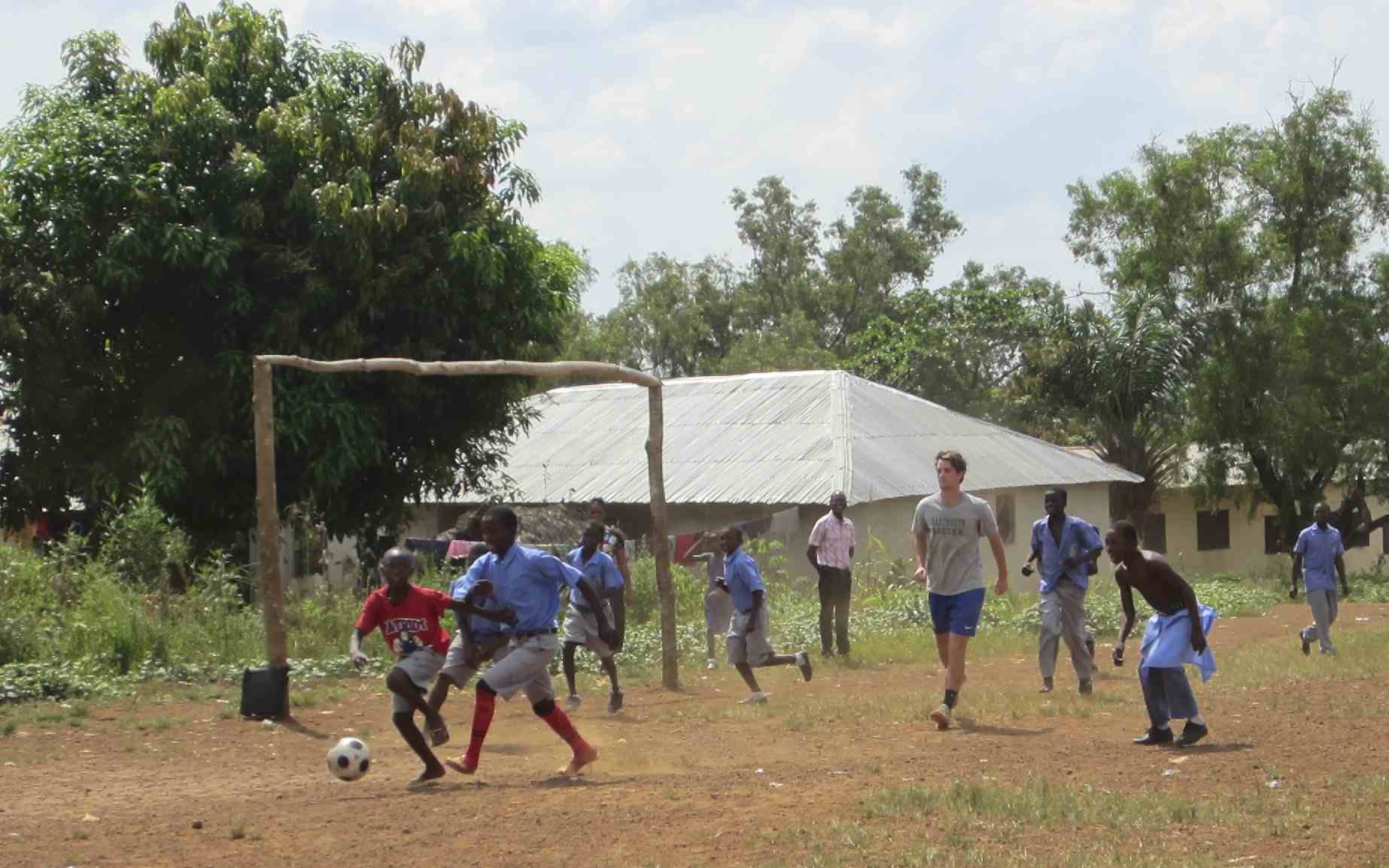
Gabe and Colin play with student of Binkolo Secondary School

Gabe and Colin play a game with student of Binkolo Secondary School

Over the rest of our stay in Sierra Leone, we visited several of the schools represented at the workshop.  We donated more balls for each school and presented Dartmouth and Falmouth T-shirts to the Peace Clubs to use for team uniforms.  The best part about every visit by far was the reaction from the students; the smiles and cheers upon seeing the balls were priceless.

And of course, we played soccer! If there was one thing we did most, it was play with the kids. Everywhere we went soccer was the medium by which Colin and I related to and got to know the communities and children.  It can be a little intimidating and even awkward to show up at a school full of children you cannot really communicate much with, but once we got the balls out the language barrier completely disappeared.  The joy that crept over each and every one of the children upon seeing the soccer balls is something I will never forget. I wish I could do a better job of describing it for others to understand.
Peace Club President at Ahmadiyya Muslim Junior Secondary School– a former child soldier during the war

Peace Club President at Ahmadiyya Muslim Junior Secondary School– a former child soldier

Interacting with the students was a very rewarding experience for me.  It was interesting just to chat with them and to hear their stories and also their reasons for wanting to be a part of a Fambul Tok Peace Club.  The president of one of the Clubs we visited was actually older than I am and is getting his education after having been a soldier during the civil war!

We also had fun answering any questions they had, which ranged from wanting to know if we had meetings under trees like they did, to if we were good at forgiving in our country (not so much, we told them).  The were especially curious about what my ‘football name’ was, referring to the one-word nicknames of famous footballers like ‘Messi’, and ‘Ronaldo’.  The students all had their own nicknames, which reminded me of the one I had when I was a little boy – people used to call me ‘Gabeto,’ synthesizing Gabe with a then-famous Brazilian star ‘Bebeto’.


Where to from here?
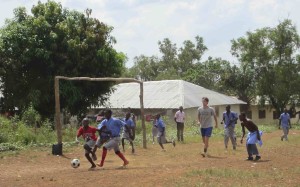
Gabe partakes in a student game at Panlap Community Secondary School

Gabe partakes in a student game at Panlap Community Secondary School

Going forward, I envision a time where every child in the Peace Clubs will have his or her own ball.  More schools are being added to Fambul Tok’s network of Peace Clubs all the time, and I hope we can support their growth and impact.  From the US side, I hope that this program will become an ongoing donation process that can persist in the Dartmouth and Falmouth soccer programs and communities for years to come.  I also hope the donations process will in turn be a vehicle for educating and engaging the American communities with Fambul Tok’s message of reconciliation and community empowerment.

I learned that it is more important to grow slowly and sustainably, rather than grow quickly or grow too much.  Rapid growth could risk corrupting the vision and values, or cause burn out and lack of following through.  I’d like the work to grow and sustain itself over time, and have an impact that lasts, all the way around.

It seems ironic to me that here I am trying to do my part impacting these children’s lives in a positive manner, yet I’m sure I was the one who came away with a part of me changed forever.  Just being there to witness how big of an impact FFT had on the children and adults alike was very moving.  The fact that I got to do this through something I love – soccer – is even more amazing.

Being involved in this project has prompted a lot of bigger picture thinking on my part. I am very much looking forward to the continuation of Footballs for Fambul Tok and want to once again thank all those who contributed.  The trip was an unforgettable experience for me and one I will treasure.  But there is always more to be done!
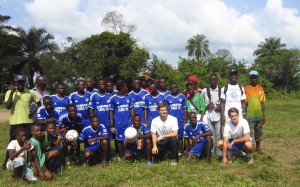
Colin and Gabe pose with a Fambul Tok team before the game

Colin and Gabe pose with a Fambul Tok team before the game

Gabe Hoffman-Johnson
Dartmouth College, Class of 2014

Visiting the Student Peace Ambassadors of Sierra Leone

The Fambul Tok Team at Ahmadiyya Muslim Junior Secondary School

The Fambul Tok Team at Ahmadiyya Muslim Junior Secondary School

One of the most significant parts of my trip to Sierra Leone this December was the opportunity to visit with the student member of the Fambul Tok Peace Clubs. We visited schools in Pujehun, Bombali, and Kornadugu districts. The main goals of our visits were to learn about how the Peace Clubs are run, learn why the students were involved and how it affected their lives, and to get to know the students on a personal level to further a connection between the Sierra Leonean Peace Clubs and the US Wan Fambul program. Another aspect of our visit was the Futbols for Fambul Tok program. Through the work of Gabe Hoffman-Jonhson and his teammate Colin Skelly, both varsity soccer players at Darmouth College, each school we visited received a donation of footballs and each Peace Club received shirts for one football team (see the blog post Futbols for Fambul Tok for more information about this program).

DSC02260

The Peace Club at St. Stephen’s Techological Vocational Secondary School sings about Fambul Tok

Our visits generally began with a school assembly or a meeting with the Peace Club, where we discussed the significance of Fambul Tok to the students and their communities. It was inspiring to hear so many young students express a desire to be Peace Ambassador; I could not help but imagine, what if US students were this interested in peace? What changes could be made if US students took ownership and asked for peace in their communities? Through talking with teachers, principles and students about Fambul Tok in these open forums, it was clear that the Fambul Tok Peace Clubs made lasting positive change in the schools and communities.

Following our discussions, Gabe presented the donations of footballs and shirts, which prompted fun, informal games with the students. This was an excellent opportunity for us to interact casually with the students and get to know them on a more personal level.

Gabe, Colin, and FT staff Bambi play with students from Binkolo Secondary School

Gabe, Colin, and FT staff Bambi play football with students from Binkolo Secondary School

In Pujehun, we visited Ahmadiyya Muslim Junior Secondary School and St. Stephen’s Techological Vocational Secondary School. At Ahmadiyya, the Peace Club president is a young man who was forced into involvement with the war. He shared with us his personal story, telling us how important it was for him to return to school and how the Peace Club directly impacts his life and enables him to move forward in his education.  After the moving assembly, while Gabe and Colin played in a student football game, I talked with many young women about school and their lives. We had a great time and found commonality in dance and hair braiding.

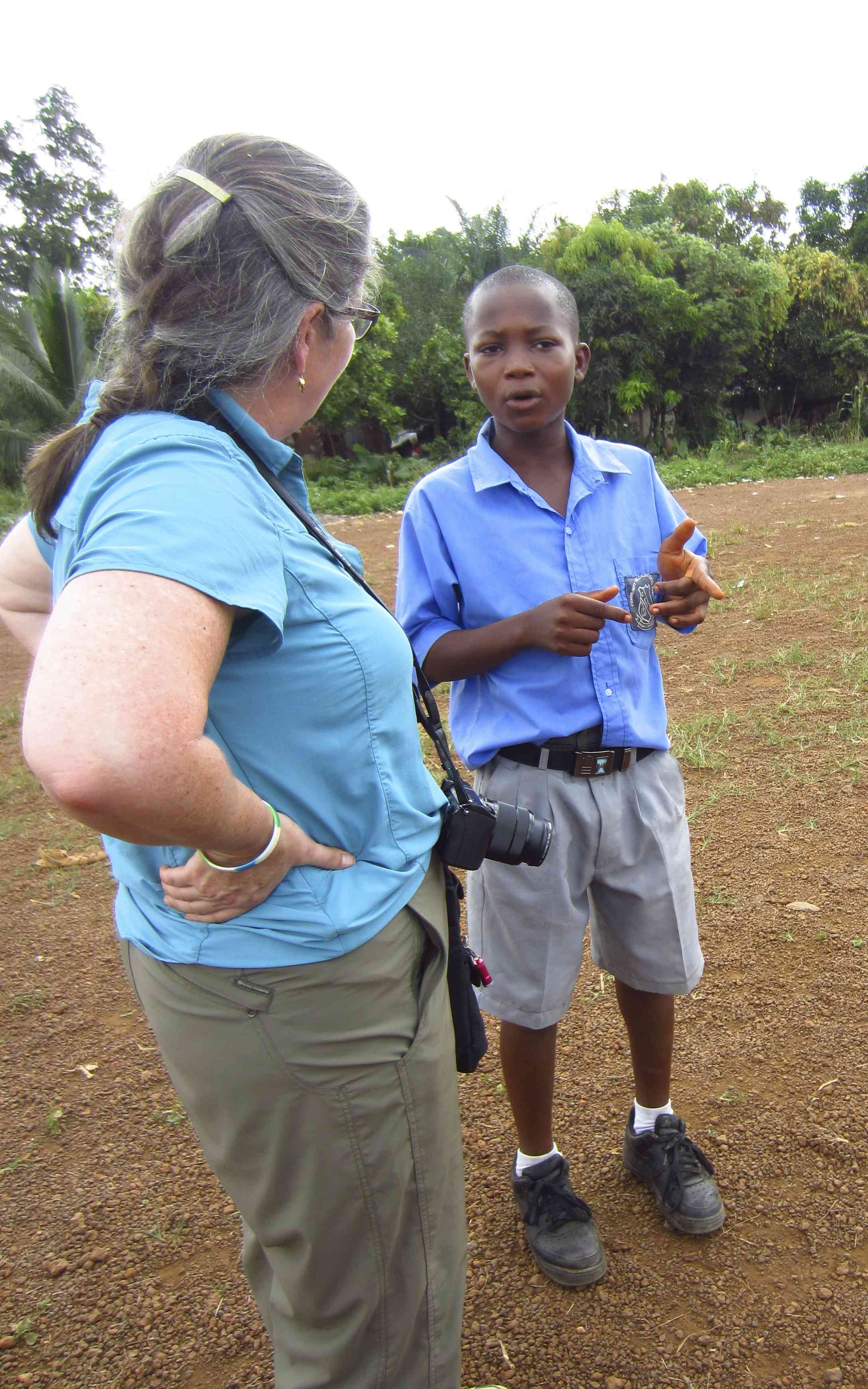
The Peace Club president at Panlap Community Secondary School converses with Libby Hoffman

The Peace Club president at Panlap Community Secondary School converses with Libby Hoffman

At St. Stephen’s we were welcomed with a song about Fambul Tok preformed by the students of the Peace Club. How thought out the lyrics were! It was such a joy to hear, through song, what Fambul Tok meant to them.

In Bombali we visited Binkolo Seconday School and Panlap Community Secondary School.

At Binkolo, the peace club students spoke so eloquently about peacebuilding; one student said he hoped to be a bridge of peace between communities and countries around the world. The students spoke of peace both of peace between families and about peace worldwide, seeing the commonality in both pursuits. There was also a clear consensus from the students that education is necessary for peace.

The Peace Club president at Panlap engaged Libby Hoffman in a great conversation about his ideas about leading in his community. He hoped to lead in bringing electricity to his village.

In Kornadugu, we visited Kabala Junior Secondary School. Here, we had a great meeting with the school principle, Albert Sheku Korio. After sharing with us about his experience during the war, he told us that he was in full sport of the Fambul Tok Peace Clubs. Mr. Korio believed that students were the answer to bringing peace to Sierra Leone and saw the Peace Club as an important tool for positive change.

DSC02653

The Kabala Junior Secondary School Peace club post football match

Without a doubt, the Fambul Tok Peace Clubs are creating community betterment and building strong student peace ambassadors. I am so lucky to have met with many of these young peacebuilders.