Paki Masabong Chiefdom’s Revolving Loan Reaches 20 Million Leones

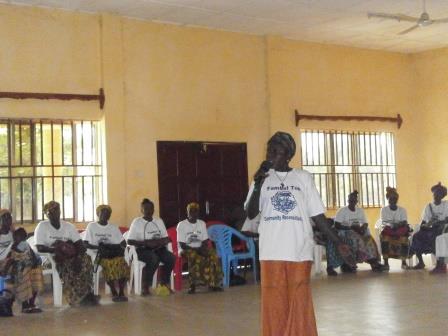
Adama addresses her colleagues during the meeting

Adama addresses her colleagues during the meeting

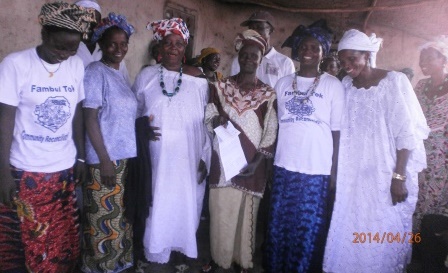
The Chairlady of the Fambul Tok Peace Mothers in Masabong section, Paki Masabong chiefdom, Bombali district in the north of Sierra Leone, during their regularly monthly meeting on June 5, 2014,  proudly announced that their usual revolving loan scheme will amount to 20,300,000 Leones in July, 2014.

Giving this update during a Peace Mothers meeting in Makuna village, Adama Lakkoh was very much optimistic about the projected amount, adding that each of the 14  villages will receive 1,265,000 Leones to embark on commercial activities.

In an overview of the loan scheme, Madam Lakkoh said it all started on August 5, 2011 after the Fambul Tok reconciliation ceremonies in their section. She said women in that section had never worked or formed any groups together, but through Fambul Tok they immediately called a meeting and discussed how they could collaborate.

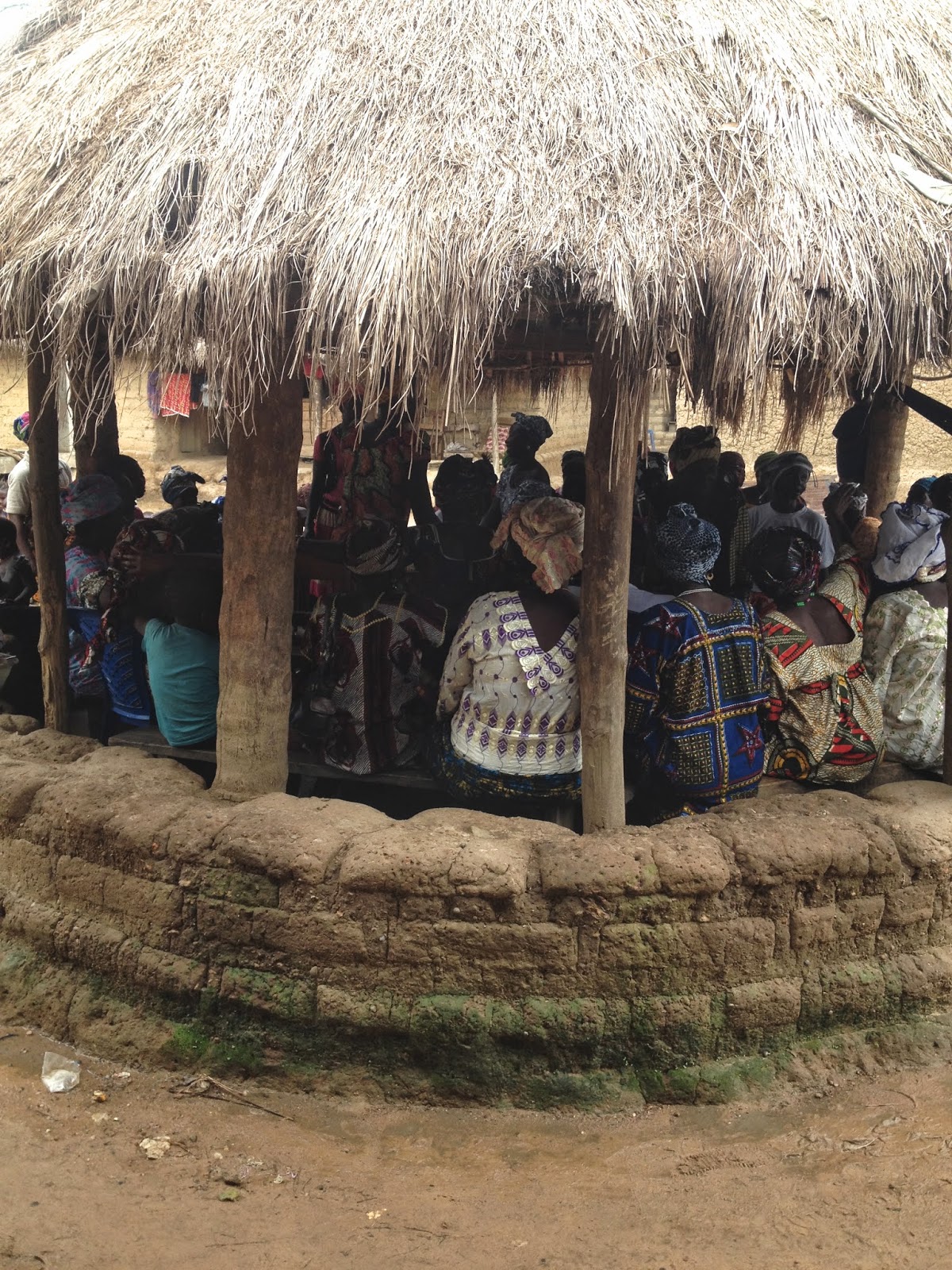
Peace Mothers in Rapt Attention

Peace Mothers in rapt attention

During the inaugural meeting in August 2011, each of the women in the 14 villages agreed to embark on revolving loan scheme. Each member was tasked to pay 5,000 Leones  at the end of every month. She explained that the seed money was re-distributed with little interest among members in their different villages to embark on small scale activities.

Every month we meet in any of the 14 villages to collect the money and after verify our records we re-distribute it among members” says Lakkoh.

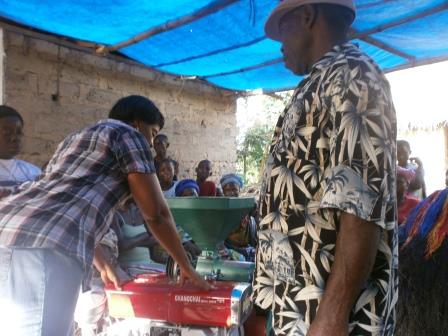
Because of the Peace Mother’s hard work, Fambul Tok, through funds from US State Department, provided a brand new rice mill for the Peace Mothers in Masabong. An oversight committee has already been set to monitor the process. During the meeting the Peace Mothers agreed to embark on store building project and in-valley swamp cultivation for this year’s farming season.

Today, after just 4 years, the women could now boost to millions of Leones with funds generated by themselves without external support. This shows that working together as a unit yields more dividends and promote development rapidly.

First Female Town Chief Crowned

Chieftaincy in any form and shape in the Northern province of Sierra Leone is a taboo for women. Many women have faced a lot of challenges for the past decades when it comes to chieftaincy or public elections in the country, thus most women have been marginalized.

The trend has started changing over the years; women are now holding positions of trust in that part of the country. Last year in Heremakono section, Wara Wara chiefdom, Mbalia Koroma, chairlady of Peace Mothers was appointed the first acting female section chief. This success is in part due to Fambul Tok’s intensive sensitization  and training programs on women rights and responsibilities in the North.

Cecilia Kanu pic

Cecilia Kanu

Recently, the people of Masongbo village, Makari Gbanti chiefdom, Bombali district, Northern Sierra Leone unanimously appointed the very first female town chief since the inception of the village. Cecelia Kanu, an adviser in the Peace Mothers group in Masongbo section went unopposed and was crowned, thus entering the guinness book of records for being the first female town chief in Masongbo.

Cecelia elevation to that  position was also a result of her dedication and commitment to advocate for more women to be involved in decision making processes. Her clarion call has started yielding fruits!

In an interview in her village, she says she believes in the emancipation of women. “This is just the beginning, I have the conviction that in a not too distant future women are expected to become Paramount chiefs in the north like in the east and south of Sierra Leone,” she emphasizes.

Madam Kanu is also the headmistress of the Roman Catholic Primary School in Masonbo village and is very active Peace Mother. She is  54 and married with four children.

Upper Bambara Peace Mothers Empowered

Lilian Morsay addresses Peace mothers

Lilian addresses Peace Mothers

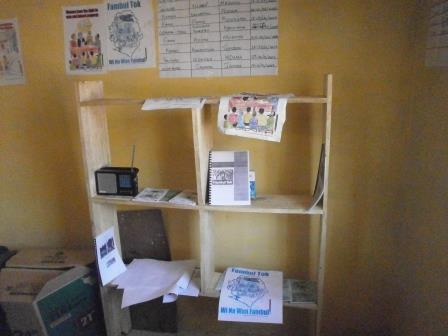
On Tuesday June 17, 2014, in continuation of its support to Peace Mothers in the country, Fambul Tok International-Sierra Leone donated a brand new rice mill and officially opened the Peace Mothers information kiosk in Siama village, Bambara section, Upper Bambara chiefdom, Kailahun district.

In a brief but very impressive relinquishing ceremonies, Fambul Tok Program Officer, Lilian Morsay underscored the importance of women working together to develop their communities. She said the handing over of the rice mill and kiosk was as a result of Peace Mothers’ hard work and commitment, adding that Fambul Tok operates in five of the six sections in the chiefdom.

O

Program Officer hands over machine to Peace Mothers in Siama

Morsay encouraged women to continue to work in the spirit of unity and development. She cautioned them to make good use of the items. Morsay went on to disclose important documents made available at the kiosk, such as the three gender acts and child rights act, local government act, and other reading materials, calling on the whole chiefdom to make use of the kiosk.

The Program Officer also said the machine is not only for Bambara section. She stated other sections would have access to it, requesting for the formation of a special committee to oversee the day to day function of the machine.

Chairlady of the Peace Mothers in Bambara section, Agnes Fatorma, could not hold back her tears as she burst into jubilation for Fambul Tok and its partners for empowering  women in the country.

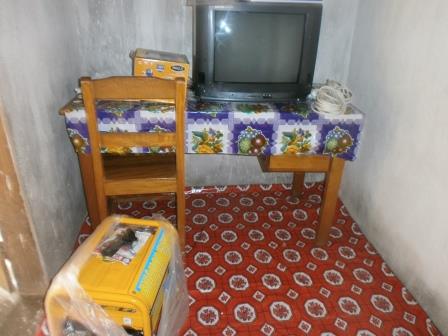
inside view of the information kiosk

Inside view of the information kiosk

Town chief of Siama, Musa Moiforay, also cautioned women to take great care of the items. The occasion was concluded with a traditional dance.


Stories from Bombali

Excerpts from Fambul Tok Volunteer Sara Waldheim’s blog, Around the World with Sara. Follow her adventures here.

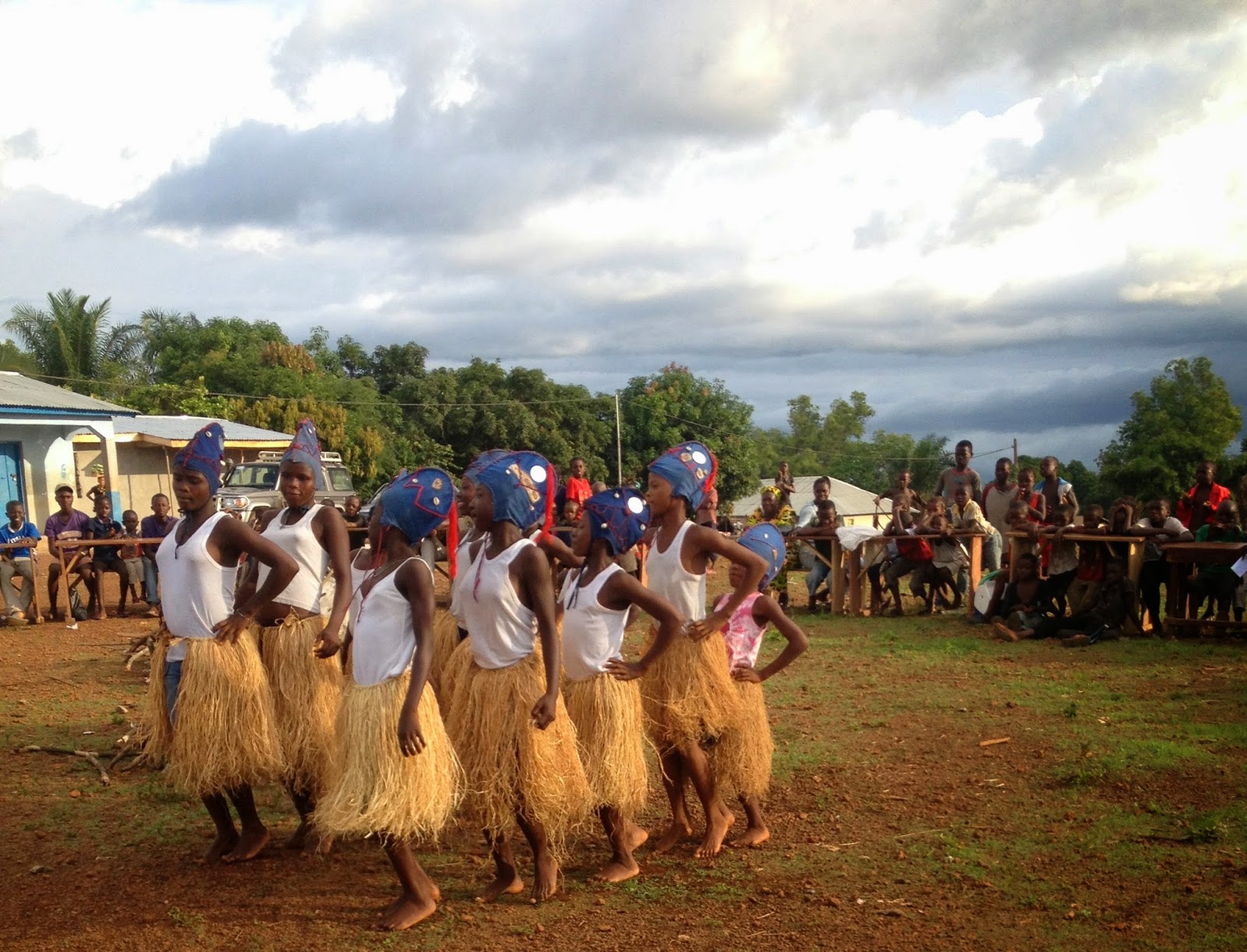
Secret Society Dancing

Secret Society student dancers


On May 31 I attended my first School Bonfire & Oral History Presentation at Panlap Community Junior Secondary School in Bombali District.

Fambul Tok is now in five schools in each of the six districts where they are active and have established Peace Clubs in each of these schools. As part of the sensitization surrounding the history of the war for the students and the whole community, Fambul Tok is holding bonfires and oral history presentations in all of their schools.

The first activity at the bonfire was a bonding football match between members of the school and two students from the nearby School for the Blind. After the match the bonfire ceremony began with introductions of the attending dignitaries including Paramount Chief Massalye.  His attendance was quite a triumph for Fambul Tok and shows the importance and success of the program.

There were many activities that took place during the bonfire. A young boy acting as an old man gave the oral history. He was outstanding in his delivery. Dancers representing the secret societies performed for us. A skit, showing some of the atrocities of the war, was presented.

Peace Mothers meeting

Peace Mothers discuss next steps

The next two activities with Fambul Tok revolved around Peace Mother meetings. The first meeting took place in the Masongbo Section, Masongbo Village.  This section earned a casava grinding machine as part of the “walk side by side” system of rewarding sections who show great initiative and capabilities. In this case, the section has a very large casava farm and needs the grinder to preserve the casava for future sales. The purpose of this meeting is to give guidance about planning for the use of the machine.  Joseph, team leader of the Fambul Tok District Staff, kicked off the meeting by establishing the purpose of the machine and giving suggestions of how the community can use the machine economically.

The next Peace Mother meeting was held in Masabong Section, Makanie Village.  The purpose of this meeting was similar to the first one, except this village was presented with a rice-milling machine as a reward for success with their rice farming.

This is was third visit to this sectional meeting of the Peace Mothers.  This is the section that has a very successful revolving loan scheme started in 2011 with 750,000SLL. A scant three years later they now have 17,000,000SLL in their account and all the villages in the section have begun businesses using the revolving loan.

“Fambul Tok Day” Declared in Kono

Since Fambul Tok kicked off its community reconciliation process in Sierra Leone, several clarion calls have been made on government by various people, including traditional leaders, to declare March 23 of every year a day of national reflection. Held on the anniversary of the start of the war, March 23rd, if  recognized by government, would encourage every Sierra Leonean to sit back and reflect on what happened during the country’s decade-long conflict and how everyone must work to ensure such a virulent war does not reoccur.

For the past few years, Fambul Tok has organized various events on March 23 in communities across Sierra Leone. In one such program orchestrated by Fambul Tok, student peacemakers added their voice to this year’s commemoration of March 23rd, calling on the Government of Sierra Leone to declare the day a national day of reflection day, not simply a public holiday.

Chief Morsay(right) embraces Komba during oral history night

Chief Morsay (right) embraces Komba during oral history night

On Friday, May 23rd, 2014, traditional leaders in Dangbaidu section, Sandor chiefdom, Kono district declared May 23rd  “Fambul Tok Day.” Prior to the declaration, the Tefeya Junior Secondary School prepared to host a quiz and oral history night (bonfire) for the student peacemakers. When the Section Chief and other traditional leaders heard about the proposed event, Chief Sahr Rodney Morsay appealed to teacher peace-coordinators and Fambul Tok staff members for the events to be held in an open place so the entire community could partake. After consultations with others, it was declared that all parents, guardians, and community members spend the day in Tefeya, not only to honor that day, but also participate in the events one way or the other.

After the quiz competition, the community stakeholders who attended said they were so impressed with the kids and emphasized that it was the very first time they had witnessed such an educative forum.

In the night during the oral history, stakeholders informed students how the war started, how it escalated, and how it ended. Questions were posed and students were cautioned not to be involved in violence, but instead help in the peacebuilding and reconciliation process in the country.

After the event, Town chief of Tefeya, Komba Kassadeh urged elders and community members to stay and witness what he referred to as, “their own bon fire.” He called on everyone who had hurt his or her fellow community member to apologize in the spirit of reconciliation.

First to testify was Sahr Komba Mani, a strong supporter of Kai Ansumana Babonjo, who contested with Kassadeh for the town chieftaincy election Tefeya. Sahr told the gathering that he had problem with chief Kassadeh during the electioneering process. On behalf of Babonjo, who was absent, Sahr asked for forgiveness for all that he did to chief Kassadeh.

In his remarks, Chief Kassadeh accepted the apology and said his then opponent was his brother and now that the electioneering process was over, they should put all hands on deck to work together. He called on anyone he had hurt during the discharge of his duties to have mercy on him. Sahr and Kassadeh, who were now on good terms, embraced each other.

Other members who had wronged each other used the occasion to reconcile.

Upon Babonjo’s arrival, he was informed about the reconciliation process that occured during his absence. Without wasting time, he visited Chief Kassadeh and dined with him that morning.

Information Kiosks Inaugurated in Nimiyama and Gbense Chiefdoms

One of the major challenges affecting rural communities in Sierra Leone is access to quality information. What often goes wrong in these communities is attributed to the lack of accurate, correct, and timely legal information. Over the years, Fambul Tok has observed that there is no locations in rural communities where people can access  accurate and timely information whenever the need arise. Most people, to a great extent, depend on” hear-say”, or what is referred to in Sierra Leone as bush radio.

Deputy Mayor declares open the kiosk in Condama

Deputy Mayor declares open the kiosk in Condama

When laws are enacted by the government of Sierra Leone, a major hurdle is figuring out how to ensure that rural villagers and illiterate people understand what the law entails. Many protocols and procedures are required by the government, but many people do not understand understand them or know their importance. Because of this detrimental lack of access to legal information, Fambul Tok International-Sierra Leone, has deemed it fit to open information kiosks in various sections and chiefdoms in Fambul Tok operational areas. The first set of information kiosks were developed in Nimiyama and Gbense Chiefdoms in Kono District, Eastern Sierra Leone.

some of the items on display

Some items on display in the kiosk

Executive Director of Fambul Tok International-Sierra Leone, John Caulker, underscored the importance of the information kiosks in his brief statement during the Peace Mothers dialogue prior to the official inauguration ceremony on May 13, 2014 at Condama town in Nimiyama chiefdom. John Caulker said Fambul Tok continues to create space for Peace Mothers to interact, to identify major challenges, and to involve stakeholders in the development processes.

front view of Bayakor peace mothers kiosk

Front view of Bayakor Peace Mothers kiosk

John Caulker stated that the information kiosks would go a long way to ensure Peace Mothers and other community members have access to quality information materials. He said the kiosks will be furnished with TVs, radio sets, DVDs, generators, and reading materials, especially regarding the gender laws and the Child’s Rights Act. Furthermore, educational posters concerning the Gender Acts and other important laws will be available for the use of the entire section and chiefdom. He discloses that the maintenance cost for the kiosks was provided to the two chiefdoms, adding that other district are expected to benefit.

The Executive Director encouraged people to use the kiosks to gather information regarding registration of customary marriages, births, and other materials available to fast track these processes. Additionally he cautioned for the judicious utilization of the items, stressing that they should be used as their own property.

On behalf of the three chair-ladies of the various sections in the chiefdom, Kumba Yarjah extended thanks and appreciation to Fambul Tok, the US Government, and other philanthropists that continue to support women, especially the Peace Mothers of Sierra Leone.

ED address peace mothers in Faada

John Caulker address Peace Mothers in Faada

Officially opening the kiosks in Condama town and Faada town, Deputy Mayor of Koidu New Sembehun City Council, Madam Theresa Sia Gbenda highlights major challenges women continue to face, focusing on access to information. She says most women do not know  the existence of gender laws, explaining that Fambul Tok is the only organization that is addressing this issue through the Peace Mothers program.

She confirms the Council’s support of women, adding that it reduced the cost for registration of customary marriage to a minimum fee of 50,000 Leones. She also called on Peace Mothers to make use of the kiosks and asked Fambul Tok to facilitate the process of registering marriages and birth in communities with the provision of vehicles or human resources when the need arises.

Stories from Koinadugu

Excerpts from Fambul Tok Volunteer Sara Waldheim’s blog, Around the World with Sara. Follow her adventures here

Easter in Kabala

Easter Sunday presented a great opportunity to attend a church service, Sierra Leone style.  A Fambul Tok staff member, Rev. Emmanuel, invited me to come with him and his family to the Wesleyan church in Kabala.  What a wonderful experience it was.

Sara Waldheim and Fambul Tok staff Ibrahim & Desmond

Sara Waldheim and Fambul Tok staff Ibrahim & Desmond

When we arrived at the church, pre-service bible study was going on with men on one side, women on the other inside the church, and youth and children outside. At the end of bible study the pastor (not Rev) instructed us to go outside and line up since we were all going to process into the church and down the aisle.

The entire service lasted for 3 hours! The actual sermon lasted about 20 minutes and was very interesting. The time flew, however, and I was amazed we had been there that long.  Getting up to dance on a regular basis sure keeps the blood flowing and the boredom at bay.

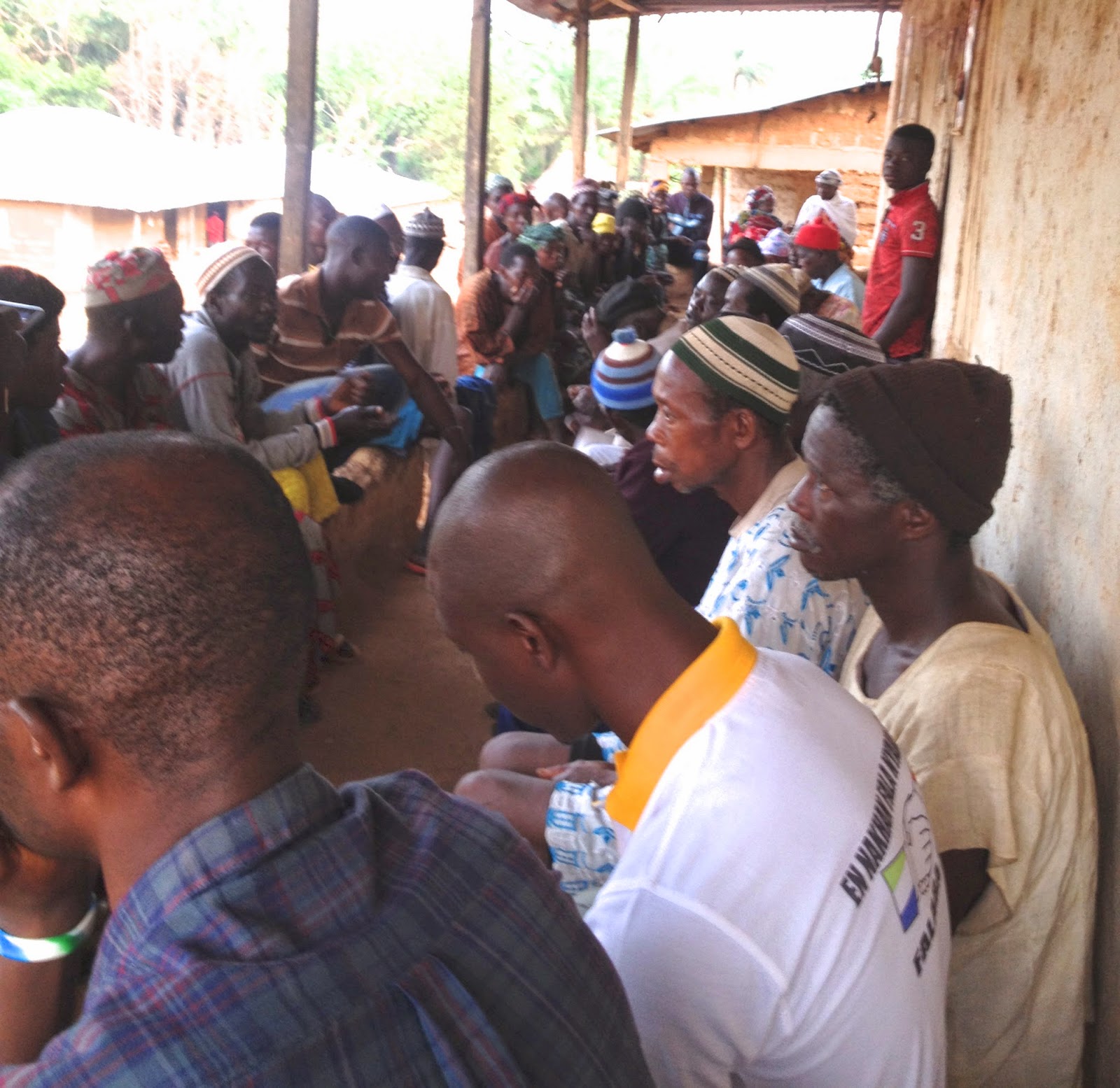
Community meeting before bonfire

Community meeting before bonfire


The next morning, Easter Monday, I joined the FT district team on visits to two villages.  The purpose was to interact with members of the Outreach Committee and the villagers, making sure they were sufficiently sensitized for the sectional Bonfire to take place on Thursday, 24 April.

Then some of us were off to an Easter Festival taking place in a remote village.  Desmond, Jalloh, Ibrahim, Rev & his son, me and Mohamed made the journey.

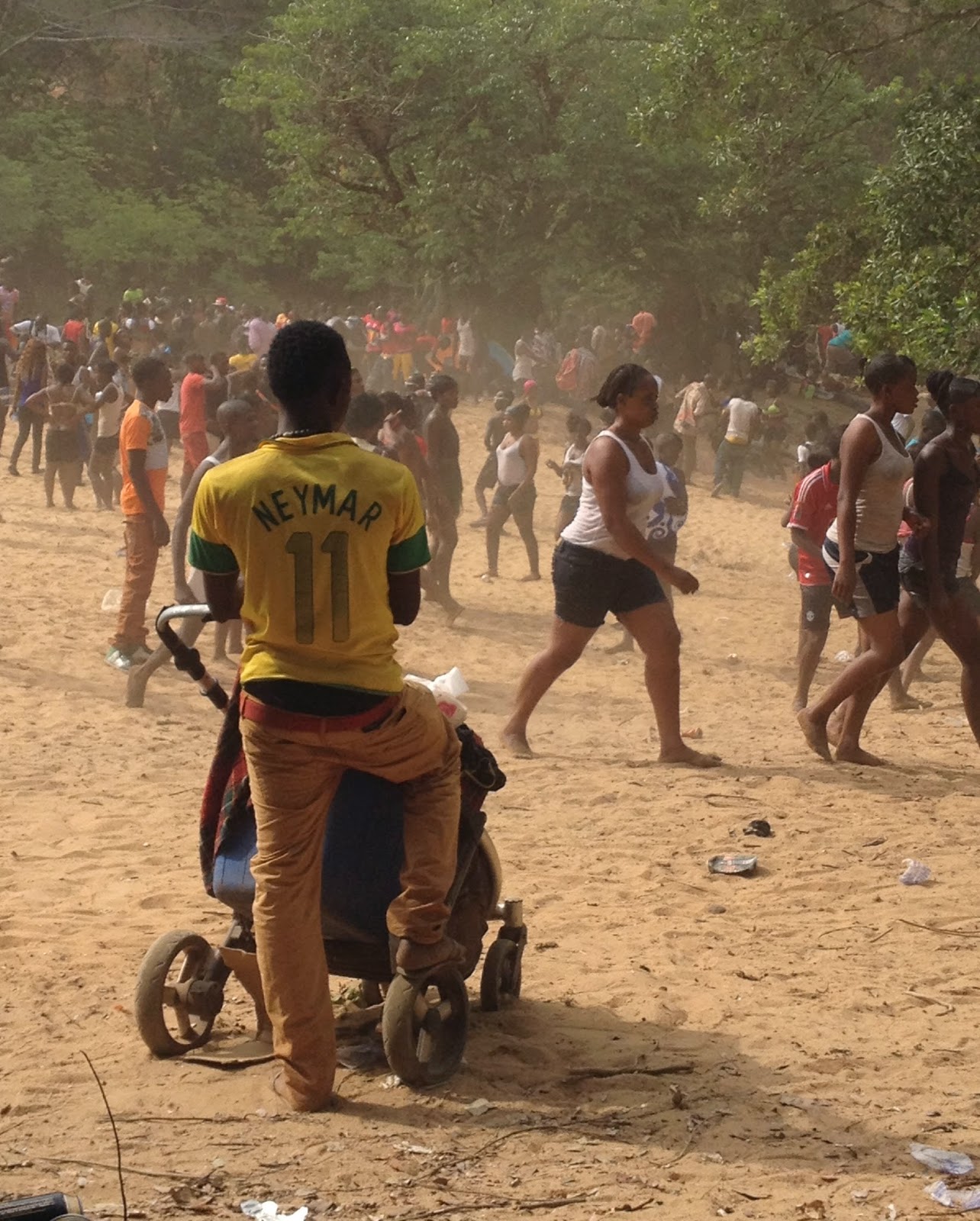
When we arrived the place was already crowded, but still spacious enough to move around.  The village was in a fabulous setting by a river with a sand beach below a wooded area with hand made bamboo benches in the shade.  I could live there!  It was so peaceful.

Great turn out for the  Easter Festival

Great turn out for the Easter Festival

We wandered around people watching, sitting and listening.  People kept arriving by the semi-truck load all piled in the back, by motorbike, cars, vans and began pouring in to the park.  It seemed that one of the FT staff or Mohamed knew at least one member of the new arrivals. At one point the attendance estimate was well over 2,000.

When we left hours later, people were still arriving and a parking space was at a premium.  I loved every minute.

Bonfire at Kathawuya Village

The last bonfire I witnessed for this season took place in Wara Wara Yagala Chiefdom, Kayakor Section, Kathawuya Village.  This village is the place where Mohamed Savage, the man called Mr. Die during the war, made his last stand towards the end of the war.

One particular story touched me on a very deep level.  Not only because of what happen, but also because of how the victim told it.  This was a difficult story to hear and will be a difficult one to read, so go no further if you feel this may be too much.

Mr. Die and his men entered this woman’s village.  She had a babe in arms and one in her belly.  After harassing the woman, her child was thrown into the bush where she could hear it crying.  At some length she was allowed to go rescue him.

At that point Mohamed told her to choose: her child’s life or her life and the life of her unborn child.  She refused to make the choice.  He then took her child from her and threw him into the fire; she was forced to watch and listen as he burned to death.  The next morning she was commanded to go through the ashes and remove the remains of her child.

She said she would never forget what happened, but that she now has seven healthy children and she needs to cleanse herself of this trauma to go forward.  She realizes she cannot change the past, but she can’t let the past poison her life now, and the lives of her other children, by filling her heart with hate.  She is willing to forgive.

Building a Storage Unit in Koinadugu

Ibrahim in front of store

Fambul Tok district staff, Ibrahim, in front of store

One of the villages in Koinadugu needed a storage unit (called a store here) for their rice so they could sell it at a higher price later in the year, when supplies are low.  Without a storage unit, rodents and bugs destroy the crop, requiring the rice to be sold at a low price immediately after harvest, when supplies are high.

The section was told to show initiative by beginning the building of the store.  They needed the land, the sticks for roof support, and the mud bricks and all the labor to build the store.  Once they have this beginning accomplished, FT provides the nails, tin for roofing, doors, and cement to finish both the inside and outside. The villagers still provide the labor for completion.

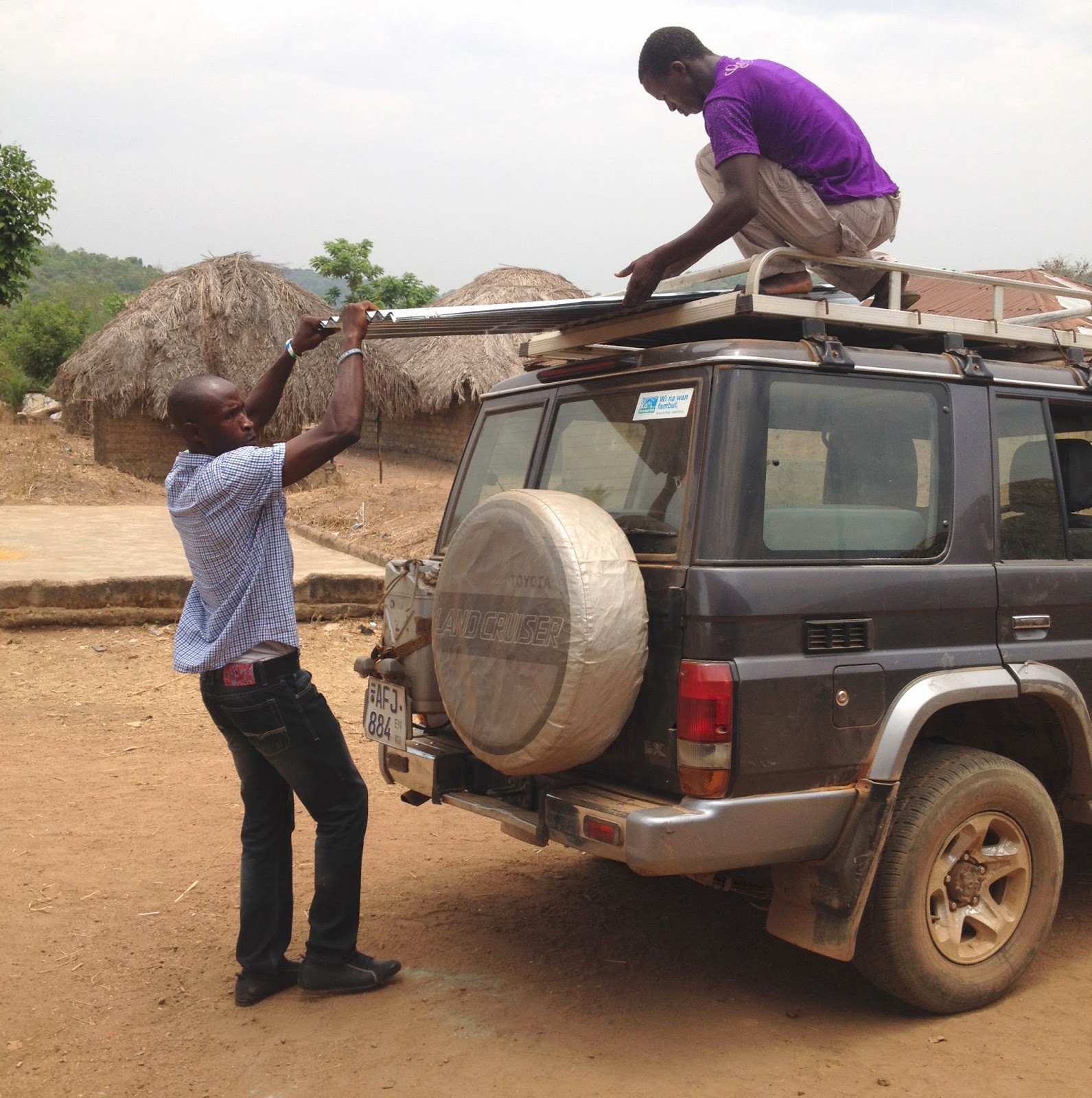
On the Tuesday after Easter Ibrahim, Rev, Desmond and I gathered the supplies from a business in Kabala to deliver to the village.
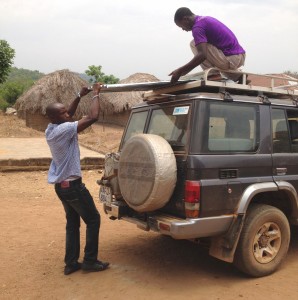
Fambul Tok staff, Rev. Emmanuel, and local villiager unloading tin

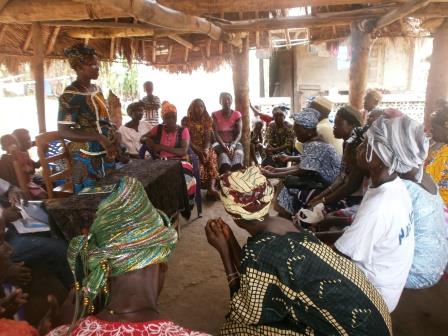
Fambul Tok staff, Rev. Emmanuel, and local villiager unloading tin
 

Support from US State Department Boosts Peace Mothers in Bombali and Koinadugu

On on April 26, 2014, through a grant from the US Department of State, Fambul Tok International – Sierra Leone facilitated the donation of two brand new machines (a rice mill and cassava grater) as well as cash micro-grants to various Peace Mothers’ groups in Bombali and Koinadugu districts.

O

Gbenikoro Peace Mothers

The rice mill was offered to Peace Mothers in Masabong section, Paki Masabong chiefdom, who requested the equipment to enable them to grow and sell more rice, and the cassava grater was donated to Masongbo section, Makari Gbanti chiefdom, Bombali district.

Handing over the machines to the two sections at a brief, but impressive ceremony in Makeni, Director of Peace Mothers for Fambul Tok, Micheala Ashwood said the funds for the Peace Mothers are from the US Government to support the growth of the Peace Mothers work. She urged beneficiaries to make good use of the machines and to extend their use to other sections in their chiefdoms.

handing over cheque in Heremakono

Handing over cheque in Heremakono

Receiving the rice mill on behalf of her section, Fambul Tok district executive chairperson, Sia Foryoh, was full of appreciation to the US Government. She also appreciated the efforts of Fambul Tok, for paving the paths for women empowerment Sierra Leone. She promised judicious utilization of the machines, adding that neighboring chiefdoms would also have access to the facilities.

Chairman Foryoh called other Peace Mother groups to work very hard, sharing that Masabong women started activity with their own little resources, and as of now they could boast having 17 million Leones in their coffers.

Masongbo, another beneficiary community that was offered the cassava grater machine,  saw their deputy chairlady assuring Fambul Tok that they would make good use of the machine. Madam Kadi Kanu highlighted constraints they were faced with; she disclosed that they had planted eight acres of cassava, but could not get assistance from any organization to support them. She shared that several organizations were approached, but none responded except Fambul Tok. She, too, was grateful to the US government.

Rice mill and Cassava grater machines on display

Rice mill and Cassava grater machines on display

The funding from the US State Department provides for small grants to Peace Mothers groups, based on income generating activities the women themselves have identified and in most cases already begun.  The additional money or equipment will allow them to achieve the next level of growth in their work, and will promote collaboration among different communities of Peace Mothers.  The pass-through grants will also be going to other Peace Mother groups in Bombali, as well as a total of twelve groups in Koinadugu District.  Those micro-grants will be roughly three million leones each.

Fambul Tok has already started handing over the grants. Three sections – Dogoloya in Folosaba Dembelia chiefdom, Heremakono 1 in Wara Wara Yagala chiefdom and Heremakono 2 in Sengbeh chiefdom – have received their cheques.

Other beneficiary districts will include Moyamba and Pujehun.

Sanity Returns to Gbanti Kamaranka Chiefdom

Story: Joseph Momoh Kargbo- Fambul Tok District Staff, Bombali district

Makulon section in the Gbanti Kamaranka chiefdom, Bombali district, Northern Sierra Leone has 10 villages. Two of the villages, Makulon and Gbintimaria, according to their chieftaincy arrangements used to alternate power peacefully.

Almost 12 years ago, after the demise of the installed section chief,  there was conflict between the two villages as to which village will provide leadership. This resulted in disconnection among families and individuals to the point that some villagers  in that section deliberately refuse to visit Makulon and Gbintimaria for fear of being intimidated or harassed. According to a resident of  Gbintimaria, Mohamed, he had earlier stopped going to church in Makulon for fear of being molested and now walks over 5 miles to attend service every Sunday. The situation worsened when finally a new section chief was crowned in Gbintimaria.

Prior to the usual bonfire in that section, it was evident that there was conflict and if not resolved, it would be very difficult for Fambul Tok to operate. During sensitization, staff had to spend a night in Gbintimaria after a heavy day’s work. On the following day, staff traveled to Makulon, but there was a cold reception. This was because the people of Makulon thought that the staff had chosen Gbintimaria to do everything; they did not want to participate!

collecting local materials for ceremonies in Makulon

Collecting local materials for ceremonies in Makulon

However, after spending several hours explaining to the residents of Makulon what Fambul Tok stands for and re-emphasising the core values, one of which is non political and non-partisan, they decided to participate, especially when they realized that Fambul Tok
is a community reconciliation program and has no connection with politics.

Many questions were posed on staff, some geared towards uniting the two divided villages. For this reason staff had to spend a night in Makulon, so everything could be put in place for the reconciliation ceremony.

To demonstrate that they want peace and unity after a decade in that section, a meeting was convened where elders of the two villages met for the very first time to plan for the reconciliation ceremony. It was agreed that  a resident of Makulon should be given the opportunity to coordinate the program.

During bonfire, other villagers were really surprise to see elders in the two conflicting villages dinning and dancing together.

The following morning after their traditional ceremonies, the staff visited neighbouring villages  and people were happy for bringing the two villages to together.


Fambul Tok Links Peace Mothers with Kono Stakeholders

One of the major challenges facing women in Sierra Leone is the lack of opportunity to meet and interact with stakeholders to discuss pertinent issues affecting the women, so that together they can find solutions to numerous problems.

A peace mother highlights needs and challenges

A peace mother highlights needs and challenges

Most women, especially in the rural communities, could not identify their own needs and do not know the channels to go through when it comes to accessing basic economic and social amenities.

As a way of bridging this gap between women and stakeholders, Fambul Tok International-Sierra Leone, with funds from the State Department (US), organized a one day interactive session aimed at discussing and finding solutions to various problems.

The session gave an opportunity to the women to ask questions relevant to the own development and empowerment.

It was very interactive, as the peace mothers asked questions that revealed how deeply conscious they are about the lack of opportunity, which holds back their development. A primary concern, among numerous concerns highlighted, is the difficulty of getting customary marriages registered. According to the women, they have readily embraced the idea of registering, especially when the law that requires them to do so is in their favor. The women also expressed frustration that only the rich and those in major towns do register their marriages at ease, while most people in the rural areas have to travel long distances.

A cross section of peace mothers

A cross section of peace mothers

Another issue that was highlighted was the registration of births and fines impose on mothers when they give birth outside health facilities. According to the women, ante-natal and post-natal facilities are far off from most settlements, whereas Traditional Birth Attendants (TBAs) are always available to provide these services. One of the Peace Mothers testified that she was forced to pay certain amount when she gave birth through the help of TBA.

Peace Mothers raised concerns about the low standards surrounding Education. They observed that limited access to government scholars is a major problem in their communities.

Responding to some of the challenges facing women in Kono district, Mayor of Koidu New Sembehun City Council, Saa Emerson Lamina, said women play vital role towards development, adding that he is very conscious of empowering women in Council. He was grateful to Fambul Tok for providing the space to interact with Peace Mothers for the first time in the district. He called on other organizations to support women in the country.

Explaining the roles of traditional leaders, Paramount Chief Aiah B.Ngongou of Gbane chiefdom said one of their main roles is to maintain laws, customs, and traditions of the land. He said traditional leaders also help to promote commerce and mediate during conflicts. He clarified that leaders do not implement projects as claimed by most people, adding that they always work with government and other non governmental organizations to ensure that whatever is given for the development of a particular chiefdom reach beneficiaries.

Paramount Chiefs in rapt attention

Paramount Chiefs in rapt attention

Paramount Chief of Soa chiefdom, Emmanuel Tamba Foryoh, encouraged Peace Mothers to report any health worker who imposes charges  on TBAs or pregnant women. He also called on authorities, especially in the health sector to provide ambulance services and create referral centers in the various chiefdoms.

After nearly five hours of  deliberations, the Peace Mothers were satisfied that they had the opportunity to interact with stakeholders and most of the issues raised were adequately answered.